welcome
|
|||||||||||||||||||||||||||||||||||||||||||||||||||||||||||||||||||||||||||||||||||||||||||||||||||||||||||||||||||||||||||||||||||||||||||||||||||||||||||||||||||||||||||||||||||||||||||||||||||||||||||||||||||||||
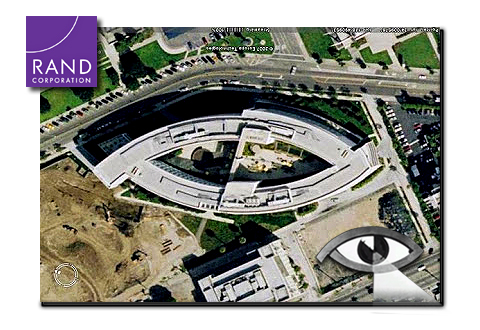
RAND CORPORATION | |||||||||||||||||||||||||||||||||||||||||||||||||||||||||||||||||||||||||||||||||||||||||||||||||||||||||||||||||||||||||||||||||||||||||||||||||||||||||||||||||||||||||||||||||||||||||||||||||||||||||||||||||||||||


| Documentation – ParadigmShift.tv | |
| Time Reference: | 02:14 |
| Description: | The home page of Paradigm Shift TV, which now broadcasts Corbett Report videos on Sky Channel 201 Friday nights at 7:00 PM UK time. |
| Link To: | ParadigmShift.tv |
| Documentation – RAND corporation homepage | |
| Time Reference: | 04:23 |
| Description: | Palatable pap and pimply politically-correct hyperbole about everyone’s favourite think-tank! |
| Link To: | Rand.org |
| Documentation – Dr. Strangelove’s survival plan | |
| Time Reference: | 08:40 |
| Description: | From Stanley Kubrick’s 1964 classic, Dr. Strangelove: or How I Learned to Stop Worrying and Love the Bomb. |
| Link To: | YouTube |
| Documentation – Herman Kahn’s Doomsday Machine | |
| Time Reference: | 11:56 |
| Description: | Yes, Strangelove was based on a real RAND researcher. |
| Link To: | tracearchive.ntu.ac.uk |
| Documentation – Herman Kahn’s Escalation Ladder | |
| Time Reference: | 15:31 |
| Description: | This is not the work of a sane mind. |
| Link To: | TexasChapBookPress.com |
| Documentation – The Trap | |
| Time Reference: | 17:55 |
| Description: | Adam Curtis’ (inevitably one-dimensional, surface-level) examination of RAND’s rational choice theory and its infiltration into our society. |
| Link To: | Google Video |
| Documentation – Soldiers of Reason | |
| Time Reference: | 27:44 |
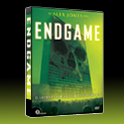
| Description: | Alex Abella’s book on what he found in the RAND corporation archives. |
| Link To: | Amazon.com |
| Documentation – Alex Abella Homepage | |
| Time Reference: | 28:20 |
| Description: | Alex Abella’s website. |
| Link To: | AlexAbella.com |
| Documentation – Homegrown Terrorism Prevention Act Raises Fears of New Government Crackdown on Dissent | |
| Time Reference: | 42:32 |
| Description: | DemocracyNOW discusses RAND’s influence on the Homegrown Terrorism Prevention Act. |
| Link To: | DemocracyNOW.org |
| Documentation – The Global Technology Revolution | |
| Time Reference: | 49:19 |
| Description: | Beyond the agricultural and industrial revolutions of the past, a global technology revolution is currently changing the world. This book discusses the broad, multidisciplinary, and synergistic trends in this revolution, including genomics, cloning, biomedical engineering, smart materials, agile manufacturing, nanofabricated computation devices, and integrated microsystems. |
| Link To: | RAND.org |

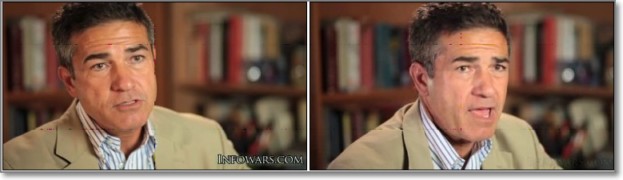
“…It goes beyond that, because for instance that’s what the Brookings Institution does. The Brookings Institution is another think tank that was founded in the 1920s, that never did have as much influence as RAND. And it’s only been now, under the Obama administration, that they’ve finally found their own voice. And a lot of the people have got into the Obama administration, whereas for decades it was RAND. You know like Donald Rumsfeld going from the RAND board of trusties to the pentagon.
-- Alex Abella, Researcher, Author, video : Rand Corp. Exposed, Corbett Report Podcast --
|
We Need to Talk About the Iran Protests
corbettreport
TRANSCRIPT, SOURCES AND MP3: https://www.corbettreport.com/?p=25512 |
Trump Recruits Zionist Neocon John Bolton for War with Iran Blackstone Intelligence Network In 2016, I predicted that Trump would bring John Bolton into his administration to prep for war with Iran. I was right. Trump's administration is completely under the control of the globalists and you have to be blind to not see it. |
USA, Israel & Saudi Arabia Prepping for Zionist War With Iran
End Times News Report
|
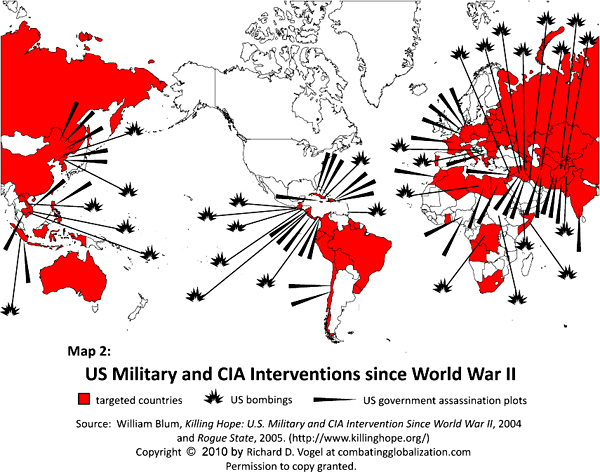
Link: C.I.A.
(the link has been updated)
ONLINE PDF:
www.brookings.edu/wp-content/uploads/2016/06/06_iran_strategy.pdf
|
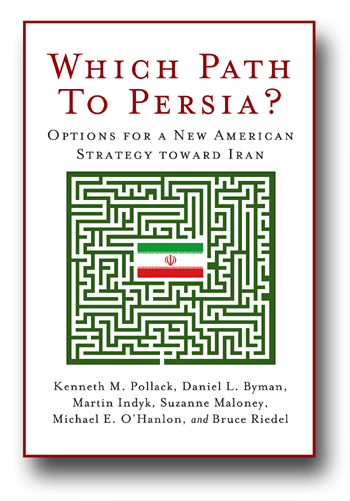
“This channel [Truthstream Media] has covered multiple times that Iran is so much in the crosshairs, it’s such a persistent target. It’s such a country that these war generals and policy wonks in Washington are salivating over, that an actual entire book was written by the Brookings Institute - yeah satan’s own think tank - raising the question, ’which path to Persia?’ Not whether there would be a conflict in Iran, not whether they seek regime change, but how to get there and maintain international credibility. And they ran through everything from a false flag attack, to a joint air strike with Israel or Saudi Arabia, to a domino situation with Syria or surrounding countries, to a PT boat confrontation and much more.” |
-- Aaron Dykes, journalist, Truthstream Media, video : While Everyone Was Busy Being Distracted by Texas… --

"What do I think this is going to lead to? Well, now this is going to give Trump the excuse for not leaving Syria in spite of the fact that most of ISIS has been relegated to pockets in the desert and there is no reason for the US troops to be there. In fact two of them were killed recently, so now this chemical attack is going to provide the perfect excuse to stay in Syria for longer. Is it going to lead to a wider regional war?…Possibly. Anything can happen at this point because it’s very easy to spark a world war if Russia feels that it’s being threatened it might attack.
…Well basically the way you have to see it is that France, Turkey, and the US are a bunch of vultures that are trying to pick off the corpse of what they believe to be a dead Syria. They are trying to basically divide the areas of control. France had its eyes on Manbij and turkey has its eyes on Manbij, cause they have this deal they want to make with the US that only everything east of the Euphrates belongs to their Kurdish proxies, and everything west of the Euphrates in the north of Syria is supposed to belong to Turkey. And France is kind of trying to carve out its own chunk. Of course at the end of the day Syria is alive. The military is strong. And the Syrian president has said that the entirety of Syria is going to be liberated.
So the idea that any of those forces are going to stay and takeover a piece of Syria is a pipe dream. And it will lead to death and WAR and destruction. Already two US troops have been killed…this is sadly you know only the beginning and for what reason?…For Syrian oil? The US has plenty of oil. It’s not about wanting more oil. It’s about making sure that Syria can’t control and use its oil to rebuild because that’s going to threaten Israel. At the end of the day, this is really just about Israel, and protecting Israeli interests."
-- Maram Susli, aka Mimi al-Laham, aka Syrian Girl --
What Just Happened, And Who Is Really Responsible? [video] WeAreChange Published on Apr 9, 2018
LINK: SYRIA
The Rand Corporation and the American Empire,
a study of the world's most influential think tank
FLASHBACK TO SEPT 28, 2010-Father of State Sponsored Terrorism (Full Interview)
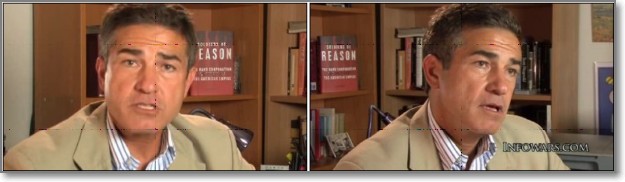
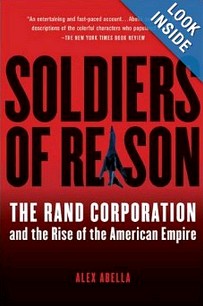
Alex talks with Emmy-nominated TV reporter and screenwriter Alex Abella, author of Soldiers of
Reason: The Rand Corporation and the American Empire, a study of the world's most influential think tank. Abella
was the first journalist to have full access to RAND's files in Santa Monica, California. Abella, who migrated with
his family to the United States at age 10 from Cuba, is also the author Shadow Enemies, a non-fiction account of a
plot by Adolf Hitler to start a wave of terror and destruction in the United States. He is also the author of
several novels, including The Killing of the Saints and The Great American.
http://www.abellaweb.com/index.html
http://www.infowars.com/
http://www.planetinfowars.com/
http://www.amazon.com/Soldiers-Reason-Corporation-American-Empire/dp/0156033445
Born in the wake of World War II, RAND
quickly became the creator of America’s anti-Soviet nuclear strategy. A magnet for the best and the brightest, its
ranks included Cold War luminaries such as Albert Wohlstetter, Bernard Brodie, and Herman Kahn, who arguably saved
us from nuclear annihilation and unquestionably created Eisenhower’s "military-industrial complex." In the Kennedy
era, RAND analysts and their theories of rational warfare steered our conduct in Vietnam. Those same theories drove
our invasion of Iraq forty-five years later, championed by RAND affiliated actors such as Paul Wolfowitz, Donald
Rumsfeld, and Zalmay Khalilzad. But RAND’s greatest contribution might be its least known: rational choice theory,
a model explaining all human behavior through self-interest. Through it RAND sparked the Reagan-led transformation
of our social and economic system but also unleashed a resurgence of precisely the forces whose existence it denied
-- religion, patriotism, tribalism.
With Soldiers of Reason, Alex Abella has rewritten the history of America’s last half century and cast a new light
on our problematic present.
Read an Excerpt from Soldiers of Reason
by Alex Abella
http://www.alexabella.com/books/soldiers-reason/excerpt.html
1
A Great Beginning
The RAND Corporation’s the boon of the world
They think all day long for a fee
They sit and play games about going up in flames
For Counters they use you and me.
—"The RAND Hymn," by MALVINA REYNOLDS
ON OCTOBER 1, 1945, less than two months after the dropping of two nuclear bombs on Japan, the commanding general of the U.S. Army Air Forces boarded a flight from Washington, D.C., to San Francisco on a trip he was certain would be as momentous as the Manhattan Project.
A man of medium stature, with pudgy features, clear eyes, and a constant smile, General Henry Harley "Hap" Arnold was a true believer in the power of the Air Force. He was one of only nine people ever to earn the rank of five-star general and the only one with that rank in the Air Force. He had received his military pilot license in 1912, and since then had pushed for an Air Force independent of the Army; he never wavered in his conviction of the usefulness of maximum destructive power in combat. On hearing doubts on the legitimacy of the Allied fire bombing in Dresden, Germany, Arnold wrote, "We must not get soft. War must be destructive and to a certain extent inhuman and ruthless."
General Arnold had welcomed the development and deployment of nuclear bombs—especially since it had fallen to the Army Air Force to deliver, and thus control, that mightiest of weapons. (By 1947 President Truman would cleave the Air Force from its Army concatenation, setting up both services as rivals for the Pentagon’s largesse.) But Arnold was concerned that the amazing concentration of scientific minds that had made possible the Manhattan Project would prove hard to duplicate under peacetime conditions.
Washington had recruited talent from far and wide for its crusade against the Axis. The production capabilities and sheer output of the country’s industries (General Motors, Ford, U.S. Steel, General Electric) had been harnessed by the best and the brightest minds from the country’s top scientific research centers (MIT, Princeton, Columbia), giving the world radar, jet fighters, the atom bomb. In the span of four years, the country had grown from a second-rate power to the greatest military behemoth in history. It was the dawn of the American New Order. Like ancient Athens and her league, it would be an empire of the willing—America’s allies willed her to rule the world and rule the world she would.
Yet now that the battle was won, the unlikely alliance that had guided the United States to victory was splitting apart. Businesses wanted to make money and scientists wanted to do research. Few wanted to put up with the military’s restrictions and low pay. General Arnold feared that if everybody went back to industry or academia, America’s enemies could one day hold sway. The likeliest adversary: our erstwhile wartime ally, the Soviet Union.
Already in March 1946, former British prime minister Winston Churchill had warned about an Iron Curtain descending on Europe. Soviet leader Joseph Stalin had shattered his wartime alliance with the United States, and his troops, firmly in control of Central and Eastern Europe, were pressuring Italy and France. Soviet boots seemed ready to crush all political opposition; it was only a matter of time before a major American-Soviet conflict developed. That was why Arnold was flying to California, to find a way to hire the best brains in the country, put them together in a space they could call their own, and have them come up with weapons nobody had ever imagined.
Even in the midst of the war, a year earlier, Arnold had requested his chief scientific adviser, a colorful Hungarian named Theodore von Kármán (who was also director of the Guggenheim Laboratories), to devise a plan to entice scientists to continue working for the Air Force during peacetime. Kármán had come up with a report called "Toward New Horizons," which called for the establishment of a new kind of scientific community, "a nucleus for scientific groups such as those which successfully assisted in the command and staff work in the field during the war," a university without students and with the Air Force as its only client. In other words, a prototype for the organization that would become RAND. Arnold had been delighted with the plan, but the exigencies of the war had made him put it aside until the right moment. That moment came when lean, steely-jawed, blue-eyed former test pilot Franklin R. Collbohm, visiting from California, came into Arnold’s office one day in September of 1945.
A fanatically fit former marine, Collbohm swam in his pool every morning, rain or shine, before going to work. He had fled his childhood environs in upstate New York for the wide skies and opportunities of the West as soon as he could, eventually becoming the right-hand man of Donald Douglas, head of Douglas Aircraft, America’s largest airplane manufacturer, and the special assistant to Arthur E. Raymond, the company’s vice president and head of engineering.
Arnold and Collbohm had met in 1942, when Collbohm procured nascent radar technology being developed at the Massachusetts Institute of Technology for the Army Air Force. Both men shared a passion for aircraft and a deep love for the armed forces, to the point that they might have been inverse images of each other—Arnold advocating for scientists among the military and Collbohm standing up for the Air Force among the intelligentsia.
Like Arnold, Collbohm was concerned with the imminent dispersal of the best brains the United States could hire, and had approached a number of officials in Washington, D.C., about finding a way to retain top scientists after the war, with little success. When he finally came to Arnold’s office, though, Collbohm did not even have to finish describing his idea for setting up an advisory group of independent scientists consulting for the military before the general slapped his desk and exclaimed, "I know just what you’re going to tell me. It’s the most important thing we can do." He told Collbohm to call Douglas right away to enlist his cooperation; they were to meet at California’s Hamilton Air Force Base in two days. Collbohm was to have a list of all the things required to make the project come to fruition—the men, the machines, the money.
Collbohm grabbed the first plane he could out of Washington, a B-25 bomber, and landed at Douglas’s Santa Monica plant. He gathered all the Douglas officials he needed for the meeting and then looked for a plane to get them to the San Francisco Bay Area. The only aircraft available was President Roosevelt’s private plane, a Douglas C-54 dubbed "The Sacred Cow," so Collbohm and his people grabbed that and flew to Hamilton in it, arriving at the base just an hour ahead of Arnold, with barely enough time to round up a luncheon for the meeting.
When the general’s B-21 rumbled into Hamilton Air Force Base, waiting for him were Collbohm, Raymond, and Douglas, whose daughter had married Arnold’s son. Arnold had brought with him Edward Bowles, a consultant from MIT who had collaborated with Collbohm in setting up the first instance of coordinated civilian and military efforts in wartime planning, the B-29 Special Bombardment Project in 1944.
Lunch was served and the men got to work. One of the chief concerns of the meeting was how the new organization would help develop the technology of long-distance missiles, which Arnold was convinced was the wave of the future. Arnold and his group were adamant that only the Air Force and no other branch of the armed forces should control the new weapon. By the time he finished his coffee, Arnold had pledged $10 million from unspent wartime research money to set up the research group and keep it running independently for a few years. Arthur Raymond suggested the name Project RAND, for research and development. Collbohm nominated himself to head the group while he looked for a permanent director. (His temporary stay would eventually stretch to more than twenty years.) And so was RAND conceived.
At first, Project RAND had no specific definition of purpose other than the very general outline hashed out in Hamilton Field—a civilian outfit to come up with new weapons. But how? Besides long-range missiles, what other kind of weapons? How many? Arnold, Collbohm, Bowles, and Douglas exchanged memos, letters, and suggestions on the future of the organization for months, but final details were not worked out until General Curtis LeMay came into the picture in late December.
Gruff, aggressive, demanding, and some would say demented, LeMay was the coldest of the cold warriors. With his bulldog swagger and "never surrender" attitude, he served as a prototype for several generals in the movie Doctor Strangelove, advocating massive attacks on the enemy—whichever enemy America happened to be facing at the time, although usually the Soviet Union—while chomping on a stogie.
Named Air Force Deputy Chief of Air Staff for Research and Development, LeMay included among his responsibilities the supervision of the new research group. Whether purposely or by the sheer serendipity that can accompany government work, LeMay turned out to be the ideal candidate to shepherd the fledgling organization. With typical impatience, he tore through the red tape hindering the birth of RAND—at one point gathering all the Air Force bureaucrats needed for budget approval in one room and refusing to let them leave until they signed off on Project RAND’s exact mission. Finally, on March 1, 1946, RAND officially was delivered. Its charter was clear: "Project RAND is a continuing program of scientific study and research on the broad subject of air warfare with the object of recommending to the Air Force preferred methods, techniques and instrumentalities for this purpose."
Unlike other government contractors, RAND would be exempt from reporting to a contracting command. Instead, the unfiltered results would be delivered straight to LeMay. LeMay made sure that Project RAND could accept or reject Air Force suggestions for research and that RAND alone would determine the overall balance of its research. In exchange, the Air Force would receive information on intelligence, plans, and programs to optimize the value of its research; nevertheless, the project in no way was meant to exempt the Air Force from its own decision-making responsibilities. In other words, RAND would always be subservient to the Air Force when it came to deciding what would get made and how.
Arnold, Collbohm, and LeMay proved prescient on the government’s need for continued assistance from independent civilian scientists in peacetime. Within a few years, a new mind-set would take hold in government: science, rather than diplomacy, could provide the answers needed to cope with threats to national security—especially vis-à-vis the growing Soviet military menace.
The United States had demobilized its armed forces after World War II; new weapons, such as the atomic bomb, were seen as cheaper and more efficient than keeping large numbers of soldiers stationed abroad. Rather than nationalize key military industries, as Great Britain and France had done, the U.S. government opted to contract out its scientific research development to private concerns. The private sector, not bound by the procurement and personnel requirements of the Pentagon, could create new weapons faster and cheaper. RAND would be a bridge between the two worlds of military planning and civilian development.
Trinity and Beyond Trailer
Declassified footage about the development of the nuclear weapon
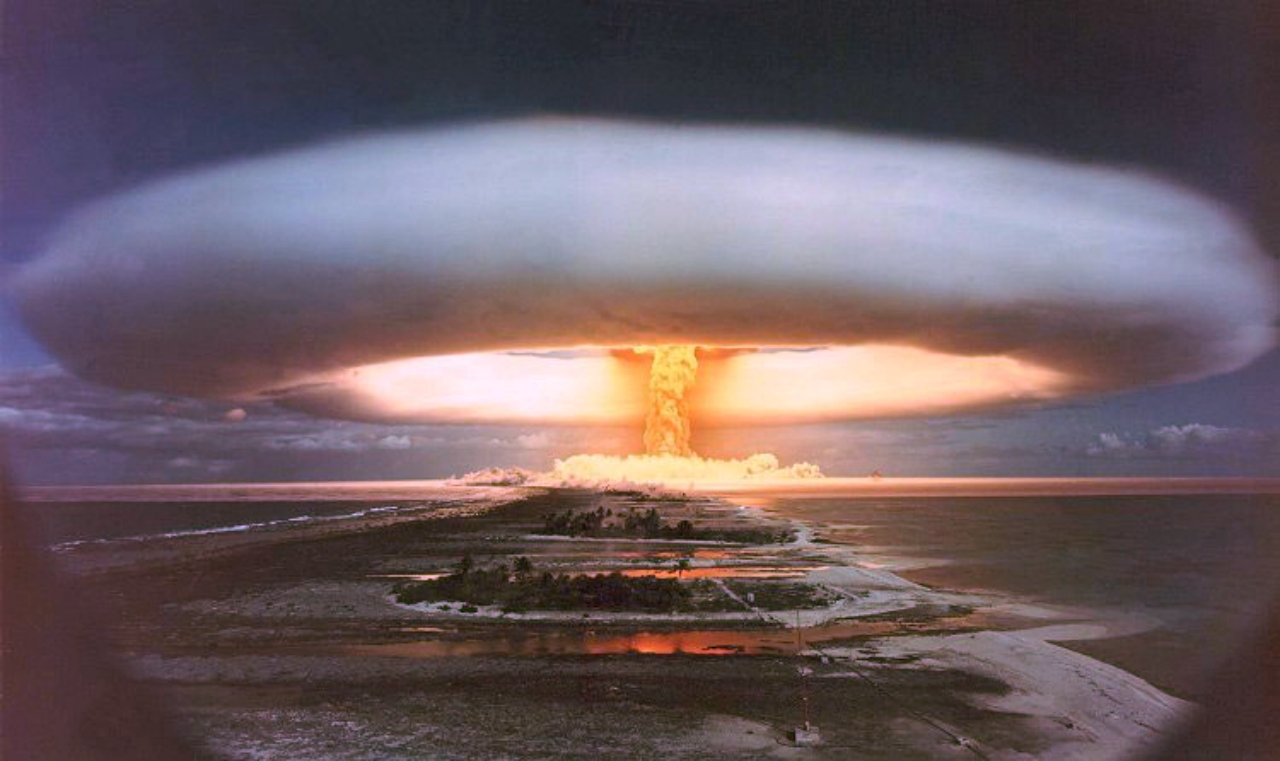
WORST U.S. NUCLEAR TEST
EVER
- SUPERF**KED
-
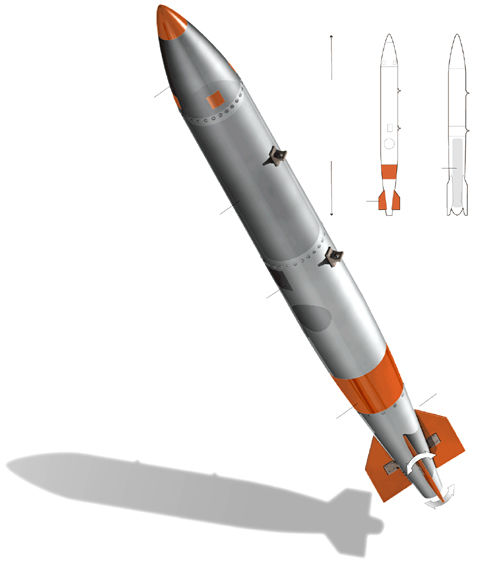
TACTICAL NUKES
The Next Phase in Fabricated War on Terror
|
Michael Chossudovsky: "The war on terror is fabricated" P-1 RealNewsOnInternet
|
|
Michael Chossudovsky: "The war on terror is fabricated" P-2 RealNewsOnInternet |
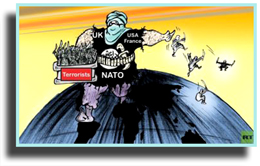
Aaron Russo talks about the CFR...And The Fabricated War On Terrorism!
The War of Terror is A CIA-Sponsored PsyOp
corbettreport
Published on Feb 12, 2017
SHOW NOTES AND MP4: https://www.corbettreport.com/?p=21807
While people on both sides of the phoney left/right divide squabble over terrorist boogeymen and Trump's CIA chief gives Saudi Arabia an award for "counter"terrorism, everyone has lost sight of the bigger picture: The blithering morons who are the face of international terror are aided, funded, controlled and handled by the intelligence agencies. It is all part of the con to get you scared of your own shadow so the terror-industrial complex can laugh all the way to the bank. Today James breaks down the latest chapter in this never-ending psy-op saga.
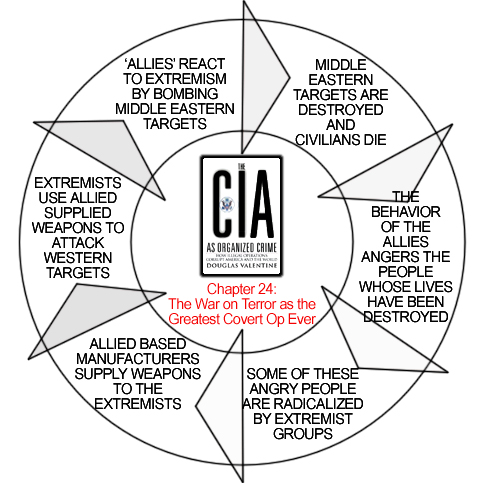
War on Terror: Greatest Covert Op
http://www.consortiumnews.com/2010/083110b.html
https://www.lewrockwell.com/author/douglas-valentine/
https://www.globalresearch.ca/america-s-war-on-terrorism/14816
https://www.globalresearch.ca/mapping-a-world-from-hell-76-countries-are-now-involved-in-washingtons-
war-on-terror/5624988
Nuclear
Warfare
in the 21st Century
As NATO and Russia revive the old nuclear Cold War, the public is being prepared to accept the first-strike use of tactical nuclear weapons on targets in the Middle East and elsewhere. And as the world inches closer to a World War III scenario, we find the old MAD doctrine being revived in a new round of madness.
Secret Meeting on the Privatization of Nuclear War Held on
Hiroshima Day 2003
Behind closed doors at Strategic Command Headquarters
At no point since the first atomic bomb was dropped on Hiroshima on August 6th, 1945, has humanity been closer to the unthinkable – a nuclear holocaust which could potentially spread in terms of radioactive fallout over a large part of the Middle East.
 All the safeguards of the Cold War era, which categorized the nuclear bomb as
“a weapon of last resort”, have been scrapped. “Offensive” military actions using nuclear warheads are now
described as acts of “self-defense”.
All the safeguards of the Cold War era, which categorized the nuclear bomb as
“a weapon of last resort”, have been scrapped. “Offensive” military actions using nuclear warheads are now
described as acts of “self-defense”.
The casualties from the direct effects of blast, radioactivity, and fires resulting from the massive use of nuclear weapons by the superpowers [of the Cold War era] would be so catastrophic that we avoided such a tragedy for the first four decades after the invention of nuclear weapons.1
During the Cold War, the doctrine of Mutually Assured Destruction (MAD) prevailed, namely that the use of nuclear weapons against the Soviet Union would result in “the destruction of both the attacker and the defender”. In the post Cold war era, US nuclear doctrine was redefined.
The dangers of nuclear weapons have been obfuscated. Tactical weapons have been upheld as distinct, in terms of their impact, from the strategic thermonuclear bombs of the Cold War era. Tactical nuclear weapons are identical to the strategic nuclear bombs. The only things that differentiates these two categories of nuclear bombs are:
1) their delivery system;
2) their explosive yield (measured in mass of trinitrotoluene (TNT), in kilotons or megatons.
The tactical nuclear weapon or low yield mini-nuke is described as a small nuclear bomb, delivered in the same way as the earth penetrating bunker buster bombs. Tactical nuclear weapons, in terms of in-theater delivery systems are comparable to the bombs dropped on Hiroshima and Nagasaki in August 1945.
The Pentagon’s 2001 Nuclear Posture Review envisaged so-called “contingency plans” for an offensive “first strike use” of nuclear weapons, not only against “axis of evil” countries (including Iran and North Korea) but also against Russia and China.2
The adoption of the NPR by the US Congress in late 2002 provided a green light for carrying out the Pentagon’s pre-emptive nuclear war doctrine, both in terms of military planning as well as defense procurement and production. Congress not only rolled back its prohibition on low yield nuclear weapons, it also provided funding “to pursue work on so-called mini-nukes”. The financing was allocated to bunker buster (earth penetrator) tactical nuclear weapons as well as to the development of new nuclear weapons.3
Hiroshima Day 2003: Secret Meeting at Strategic Command Headquarters
On August 6, 2003, on Hiroshima Day, commemorating when the first atomic bomb was dropped on Hiroshima (August 6 1945), a secret meeting was held behind closed doors at Strategic Command Headquarters at the Offutt Air Force Base in Nebraska.
Senior executives from the nuclear industry and the military industrial complex were in attendance. This mingling of defense contractors, scientists and policy-makers was not intended to commemorate Hiroshima. The meeting was intended to set the stage for the development of a new generation of “smaller”, “safer” and “more usable” nuclear weapons, to be used in the “in-theater nuclear wars” of the 21st Century.
In a cruel irony, the participants to this secret meeting, which excluded members of Congress, arrived on the anniversary of the Hiroshima bombing and departed on the anniversary of the attack on Nagasaki. More than 150 military contractors, scientists from the weapons labs, and other government officials gathered at the headquarters of the US Strategic Command in Omaha, Nebraska to plot and plan for the possibility of “full-scale nuclear war”, calling for the production of a new generation of nuclear weapons – more “usable” so-called “mini-nukes” and earth penetrating “bunker busters” armed with atomic warheads.4
According to a leaked draft of the agenda, the secret meeting included discussions on “mini-nukes” and “bunker-buster” bombs with nuclear war heads “for possible use against rogue states”:
We need to change our nuclear strategy from the Cold War to one that can deal with emerging threats… The meeting will give some thought to how we guarantee the efficacy of the (nuclear) stockpile.5
The Privatization of Nuclear War: US Military
Contractors Set the Stage
The post 9/11 nuclear weapons doctrine was in the making, with America’s major defense contractors directly
involved in the decision-making process.
The Hiroshima Day 2003 meetings had set the stage for the “privatization of nuclear war”. Corporations not only reap multibillion-dollar profits from the production of nuclear bombs, they also have a direct voice in setting the agenda regarding the use and deployment of nuclear weapons.
The nuclear weapons industry, which includes the production of nuclear devices as well as the missile delivery systems, etc., is controlled by a handful of defense contractors with Lockheed Martin, General Dynamics, Northrop Grunman, Raytheon and Boeing in the lead. It is worth noting that barely a week prior to the historic August 6, 2003 meeting, the National Nuclear Security Administration (NNSA) disbanded its advisory committee which provided an “independent oversight” on the US nuclear arsenal, including the testing and/or use of new nuclear devices.6
The above text is an excerpt from Michel Chossudovsky’s Towards a World War Three Scenario, The Dangers
of Nuclear War.
E-Book Series No. 1.0
Global Research Publishers
Montreal, 2011,
ISBN 978-0-9737147-3-9
76 pages (8.5×11)
Tables, color photographs, maps, text boxes.
Active hyperlinks to major references in the text, hyperlinked footnotes.
For further details click here
Order your pdf of this important new book from Global Research here
Introductory offer: $5.00 (plus $1.50 processing fee. Sent directly to your email!)
OR receive this book FREE with your Global Research Annual Membership! Click to learn more.
Michel Chossudovsky: North Korea and the danger of nuclear war
Paul S. Graham
Published on Jan 17, 2018
Winnipeg, January 15, 2018: Among his many accomplishments, Michel Chossudovsky is professor emeritus at the
University of Ottawa and founder of the Centre for Research on Globalization. He spoke at the University of
Winnipeg on the history of the United States' conflict with North Korea and the prospects for nuclear war. His
visit was sponsored by Peace Alliance Winnipeg, Menno Simons College, CKUW-FM and the Geopolitical Economy Research
Group.
Links:
https://www.globalresearch.ca/what-yo...
http://globalresearch.ca
http://peacealliancewinnipeg.ca
https://geopoliticaleconomy.org/
http://www.mscollege.ca/
https://ckuw.ca/
Video Production
Paul S. Graham
http://paulsgraham.ca
The Strategies of Global Warfare: War with
China and Russia?
Washington’s Military Design in the Asia-Pacific
By Prof Michel Chossudovsky
Global Research, November 07, 2017
Global Research 22 August 2016
First published in August 2016, this article documents US war plans directed against China and Russia. It
should be understood that from a strategic point of view, US threats against North Korea are a stepping stone
towards China and Russia.
Highlights;
The Contemporary Context involves a scenario of a nuclear attack on Russia. “Kill the Russians”: The New Cold War is no longer Cold
A former CIA Official is calling for the “Killing of Russians”. The US media and the the State Department applaud. (scroll down for more details)
Michel Chossudovsky, November 7, 2017
***
Introduction
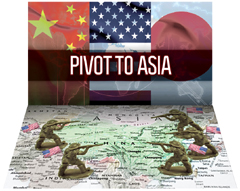
It is important to focus on Southeast Asia and East Asia in a broader geopolitical context. China, North Korea as well as Russia are potential targets under Obama’s “Pivot to Asia”, involving the combined threat of missile deployments, naval power and pre-emptive nuclear war.
We are not dealing with piecemeal military endeavors. The regional Asia-Pacific military agenda under the auspices of US Pacific Command (USPACOM) is part of a global process of US-NATO military planning.
US military actions are carefully coordinated. Major military and covert intelligence operations are being undertaken simultaneously in the Middle East, Eastern Europe, sub-Saharan Africa, Central Asia and the Asia Pacific region. In turn, the planning of military operations is coordinated with non-conventional forms of warfare including regime change, financial warfare and economic sanctions.
The current situation is all the more critical inasmuch as a US-NATO war on Russia, China, North Korea and Iran is part of the US presidential election debate. War is presented as a political and military option to Western public opinion.
The US-NATO military agenda combines both major theater operations as well as covert actions geared towards destabilizing sovereign states. America’s hegemonic project is to destabilize and destroy countries through acts of war, support of terrorist organizations, regime change and economic warfare.
While, a World War Three Scenario has been on the drawing board of the Pentagon for more than ten years, military action against Russia and China is now contemplated at an “operational level”. U.S. and NATO forces have been deployed in essentially three major regions of the World:
-
The Middle East and North Africa. Theater wars and US-NATO sponsored insurgencies directed against Afghanistan, Iraq, Libya, Syria, Yemen under the banner of the “Global War on Terrorism”
-
Eastern Europe including Poland and Ukraine, with military maneuvers, war games and the deployment of military hardware at Russia’s doorstep which could potentially lead to confrontation with the Russian Federation.
-
The U.S. and its allies are also threatening China under President Obama’s “Pivot to Asia”.
-
Russia is also confronted on its North Eastern frontier, through the deployment of NORAD-Northcom
-
In other regions of the World including Latin America and sub-Saharan Africa, US intervention is geared towards regime change and economic warfare directed against a number of non-compliant countries: Venezuela, Brazil, Argentina, Ecuador, Bolivia, Cuba, Salvador, Honduras, Nicaragua.
In sub-Saharan Africa, the thrust has largely used the pretext of “Islamic terrorism” to wage counterterrorism ops under the auspices of the US Africa Command (USAFRICOM).
In South Asia, Washington’s intent is to build an alliance with India with a view to confronting China.
Full Article :
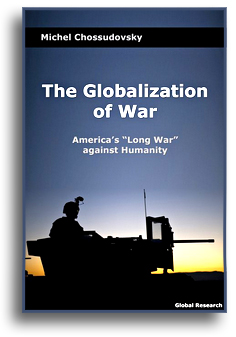
[To order Michel Chossudovsky’s book from Global Research goto the link below]
https://store.globalresearch.ca/store/the-globalization-of-war-americas-long-war-against-humanity/
China and the New World Order
corbettreport
Published on Nov 9, 2014
SHOW NOTES AND MP3: http://www.corbettreport.com/?p=12816
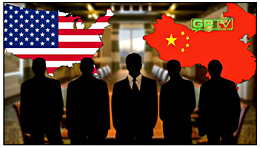
Military tensions, cyber espionage accusations, a brewing currency war; with every passing day, the headlines paint a convincing portrait of an emerging cold war between China and the West. But is this surface level reality the whole picture, or is there a deeper level to this conflict? Is China an opponent to the New World Order global governmental system or a witting collaborator with it? Join us in this in-depth edition of The Corbett Report podcast as we explore China's position in the New World Order.
Whitney is joined by James Corbett of the Corbett Report to discuss the overlap between the oligarchs of China and the United States and how the rise of China is intimately tied to Wall Street and Globalism. Published on 09/28/21.
SHOW NOTES
https://www.corbettreport.com/interview-1664-james-corbett-talks-china-on-unlimited-hangout/
|
USA-------------------------------------------------------------------------> CHINA |
||||
|
Huxleyan Model You Are Being Gamed _____________________________ |
|
Orwellian Model Sesame Credit: China's Creepy New Social Engineering Experiment |
||
|
CHINA<----------------------------------------------------------------------------- USA |
||||
|
https://www.technocracy.news/trump-agrees-with-dems-on-2-trillion-infrastructure/
|
||||
|
|
||||
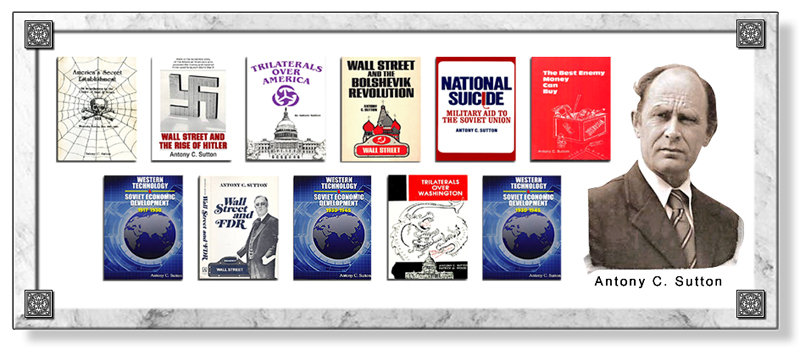
More Here: General Summary/Crash
Course , Full Spectrum
Dominance , Wall Street , TOTAL POPULATION CONTROL
|
The Coming War On China
|
Echoes of WWI: China, the US, and the Next "Great" War
|
General MacArthur's Conspiracy To Start A War With China! New Documentary Release & Interview!
|
|
The Big Picture RT
For more information on the stories we've covered visit our websites at thomhartmann.com - freespeech.org - and RT.com. You can also watch tonight's show on Hulu - at Hulu.com/THE BIG PICTURE and over at The Big Picture YouTube page. And - be sure to check us out on Facebook and Twitter! |
corbettreport
In the early 20th century, the world’s dominant superpower looked warily on the rise of a competitor to its supremacy. The machinations of the British to contain the rise of Germany led inexorably to the First World War. Once again in the early 21st century, the world’s dominant superpower is looking warily on the rise of a competitor. Will the American Empire’s machinations to contain the rise of China lead to the Third World War? Or is the American/Chinese conflict another engineered conflict for the benefit of the few at the expense of the many? Join James Corbett as he presents "Echoes of World War I" to the Open Mind Conference in Copenhagen, Denmark. |
Newsbud
Only a few years after Hiroshima and the end of World War II, President Harry S. Truman was confronted with the horrifying prospect of another nuclear holocaust. General Douglas MacArthur’s anti-communist fervor impelled him to pursue his own war strategy in Asia, conspiring against Truman’s official policy to incite Red China by sending the USS Bole on a secret mission three miles off the Chinese Pacific coast. The servicemen who crewed that battleship was recruited to the General’s rogue plan without their knowledge and threatened into silence for decades, until now. This is their story and one we are all lucky they lived to tell. Told here for the first time is the incredible story of the operation that triggered Truman's removal of Douglas MacArthur: the secret China mission of the US Navy destroyer USS John A. Bole. Featuring testimonies of servicemen on the John A. Bole and newly declassified documents, this documentary goes behind the scenes in Washington, London, and aboard the Bole to reveal Truman's relief of MacArthur was not a question of choice; it was a matter of desperate necessity. Available on Amazon: http://amzn.to/2fI6m5K DVD Available at Newsbud: http://bit.ly/2wObnzk Available on Vimeo: http://bit.ly/2xKEyW6 |
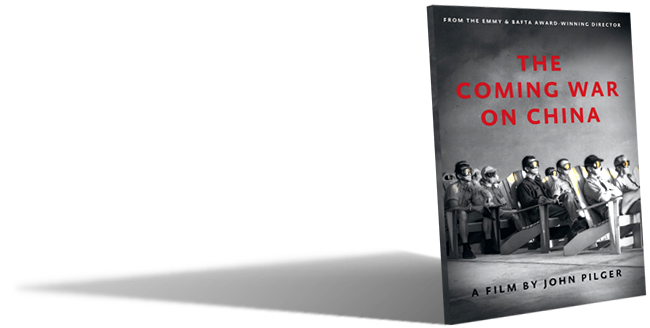
The Coming War on China
'The Coming War on China' is a film for cinema and TV by John Pilger...**** 4 stars
"A gripping film ... a strong corrective to our bland and complacent indifference"
Peter Bradshaw, Guardian**** 4 stars
"Essential viewing"
Radio Times**** 4 stars
"A film that will change hearts and minds"
The Upcoming"Shocking, terrifying, disturbing"
Entertainment Focus"The kind of stark warning we need"
Cinevue
"The aim of this film is to break a silence: the United States and China may be on the road to war, and nuclear war is no longer unthinkable"John Pilger
This new feature-length documentary by award-winning
journalist and filmmaker John Pilger is his 60th film for television. Coming straight after the election of
President Trump, the film is one of John Pilger's most timely and urgent investigations. As Trump threatens China
with a trade war and worse, this film is both a warning and an inspiring story of people's resistance.
Filmed over two years in the Marshall Islands, Japan, Korea, China and the United States, The Coming War on China reveals a build-up to war on the doorstep of China. More than 400 US military bases now encircle China in what one strategist calls "a perfect noose".
Bringing together rare archive and interviews with witnesses, Pilger reveals America's secret history in the region - he destruction of much of life in the Marshall Islands, once a paradise, by the explosion of the equivalent of one Hiroshima every day for 12 years, and the top secret 'Project 4.1' that made nuclear guinea pigs of the population.
Pilger and his crew chartered a plane to the irradiated island of Bikini where the 1954 Hydrogen Bomb poisoned the environment forever. He reports: "As my aircraft banked low over Bikini atoll, the emerald lagoon beneath me suddenly disappeared into a vast black hole, a deathly void. When I stepped out of the plane, my shoes registered "unsafe" on a Geiger counter. Almost everything was irradiated. Palm trees stood in unworldly formations, unbending in the breeze. There were no birds. It was a vision of what the world can expect if two nuclear powers go to war."
In key interviews - from Pentagon war planners in what is now Donald Trump's Washington, where the undeclared strategy is "perpetual war", to members of China's new political class who rarely feature in Western reports - Pilger's film challenges the notion of the world's newest, biggest trading nation as an enemy.
Edited in chapters, The Coming War is also about the human spirit and the rise of an extraordinary resistance in faraway places. On the Japanese island of Okinawa, home to 32 US bases - where the population lives along a razor-wired fenceline and beneath the screeching of military aircraft - Okinawans are challenging the greatest military power in the world, and succeeding.
One of the resistance leaders is Fumiko Shimabukuro, aged 87. A survivor of the Second World War, she took refuge in beautiful Henoko Bay, which she is now fighting to save. The Japanese government wants to fill in much of the bay to extend runways for US bombers. "For us," she told me, "the choice is silence or life."
Across the East China Sea lies the Korean island of Jeju, a semi- tropical sanctuary and World Heritage Site declared "an island of world peace". On this island of world peace is one of the biggest military bases in Asia, aimed at China - purpose-built for US aircraft carriers, nuclear submarines and missile destroyers.
For almost a decade the people of Jeju have been peacefully resisting the base. Every day, twice a day, farmers, villagers, priests and supporters from all over the world stage an extraordinary Catholic mass that blocks the gates. Every day, police remove the priests and the worshippers, bodily, and their altar. It is a silent, moving spectacle. One of the leaders, Father Mun Jeong-hyeon, says: "I sing four songs every day at the base. I sing in typhoons - no exception."
From Jeju, Pilger flew to Shanghai. "When I was last in China," he says, " the loudest noise I remember was the tinkling of bicycle bells; Mao Zedong had recently died, and the cities seemed dark, forbidding places. Nothing prepared me for the astonishing changes that had taken place."
He interviews Lijia Zhang, a Beijing journalist and typical of a new class of outspoken mavericks. Her bestselling book has the ironic title, Socialism Is Great! She grew up during the chaotic and brutal Cultural Revolution and has lived in the US. A critic of her own country, she also rejects outdated stereotypes. "Many Americans imagine," she said, "that Chinese people live a miserable, repressed life with no freedom whatsoever. The [idea of] the yellow peril has never left them... They have no idea there are some 500 million people being lifted out of poverty."
China today presents exquisite ironies, not least the house in Shanghai where Mao and his comrades secretly founded the Communist Party of China in 1921. Today, it stands in the heart of a very capitalist shipping district; you walk out of this Communist shrine with your plastic bust of Mao into the embrace of Starbucks, Apple, Cartier.
Eric Li, a Shanghai venture capitalist and social scientist, tells Pilger: "I make the joke: in America you can change political parties, but you can't change the policies. In China you cannot change the party, but you can change policies. The political changes that have taken place in China this past 66 years have been wider and broader and greater than probably any other major country in living memory."
The world is shifting east, and America's dominance is ending. Once subjugated, scorned and impoverished, China is rising inexorably as the world's banker and builder. Will all this be allowed to happen peacefully? "We need to make America strong again," says President-elect Donald Trump. "We need to make America great again ... and we need victories."
'The Coming War on China': Film Review
by Neil Young, 12 December 2016
A persuasively partisan example of old-school investigative journalism, John Pilger's documentary is his fourth project to straddle cinema and small-screen exposure.
From Taiwan telephone tete-a-tete to pre-Christmas game of drones, President-elect @realDonaldTrump is inadvertently doing his darnedest to endow John Pilger's eye-opening polemic The Coming War on China with an air of chillingly urgent topicality. The Australian-born journalist's 60th film for UK broadcaster ITV is his fourth to be made with cinema exposure in mind - it screened to strong receptions in British theaters the day before its similarly well-received late-evening network bow. And this authoritative indictment of American nefariousness in the western Pacific looks set to eclipse predecessors The War on Democracy (2007), The War You Don't See (2010) and Utopia (2013) in terms of multi-platform global buzz.
But while the title and premise may lead viewers to expect a Cassandra-chronicle of potential upcoming flashpoints between the countries with the two biggest economies and the two biggest armies in the world, Pilger's scope is much broader, his historical perspective much longer. Indeed, the PEOTUS only pops up fleetingly and belatedly - receiving his first name-check at the 107-minute mark in a 113-minute film, as narrator Pilger comments that "the new president" was swept into office at a time when the U.S. and China had already been at "the edge of war" for some time.
The Coming War on China is effectively an elaborately illustrated extension of a lecture Pilger delivered at Sydney University in March titled 'A World War Has Begun,' in which he expounded on why he viewed an H.R. Clinton presidency with at least as much dread as a D.J. Trump one. "Most of America's wars (almost all of them against defenseless countries)," Pilger opined, "have been launched not by Republican presidents but by liberal Democrats: Truman, Kennedy, Johnson, Carter, Clinton, Obama."
Charismatic and eloquent, and looks-wise little changed from the times of his 1970s breakthrough with films like the Cambodia-exposé Year Zero (1979), Pilger is a practiced and skilled orator. His oft-sardonic narration here is seasoned with the tirelessly globetrotting experience of a man who became chief foreign correspondent of London's Daily Mirror when @realJFK and @realLBJ ruled the White House.
But where The Coming War on China - an unapologetically partisan example of old-school, generously funded, investigatory journalism - stands out is the range of voices and faces with which Pilger (working with editor Joe Frost) shares the spotlight. As is standard for this particular behind-the-headlines sub-genre, Pilger includes talking-head commentary from expert observers such as Chinese political scientist Eric Li (who shrewdly contrasts the coexistence-oriented philosophy of Buddhist-inflected East with the conflict-sparking conversion-minded approach of the Judeo-Christian West) and American writer James Bradley, author of The China Mirage: The Hidden History of American Disaster in Asia.
Crucially, Pilger allots just as much time to the ordinary victims of this "disaster" - as personified by the long-suffering citizens of the Marshall Islands, an archipelago physically ("they came here and destroyed our lands") and socio-economically ("apartheid in the Pacific") ravaged by post-World War II American nuclear testing and ongoing military presence. Each of these speakers is accorded the dignity of being identified by name via onscreen caption, a courtesy sometimes overlooked by even the most well-meaning documentarians, and their first-person testimony is harrowing, moving and cumulatively anger-rousing.
Pilger devotes the whole first segment ('The Secret of the Marshall Islands') of his four-chapter film to a subject which may strike some as being only tangentially related to the matter nominally at hand. But it´s clear no accident that Pilger accords senior Marshall Islands citizen Rinok Riklon so much more screen time than Donald John Trump, the imminent proximity of whose diminutive digits to the nuclear button is currently giving much of the world apocalyptic nightmares.
Pilger himself contributes to such grim forebodings in his concluding chapter ('Empire'), which includes animated visions of mushroom-cloud annihilation accompanied by Frost´s suitably doom-laden music - like the film as a whole, the scoring is conventional in style but generally effective. But the closing moments, as well as finally introducing Trump in understatedly ominous fashion, strive hard to conclude matters on a note of inspirational optimism. As well as the US, China and (conspicuously backgrounded here) Russia, Pilger discerns that there is "another superpower, and this is us. Ordinary people everywhere." From Standing Rock, to the world? We shall all soon see.
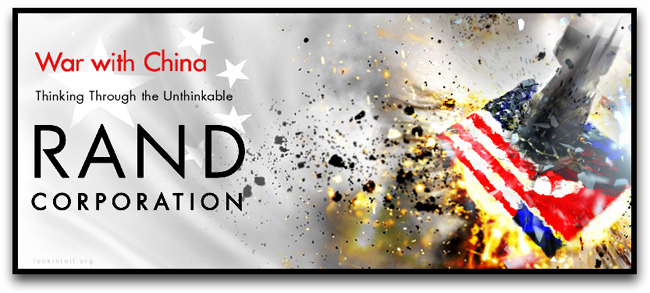
RAND CORPORATION
This top secret think tank has been
pulling the strings of
American government for at least 60 years
|
Wayne Madsen & Alex Jones: North Korea Attack Part Of RAND Plan For Total War? 1/2 The Alex Jones Channel
https://www.infowars.com/north-korea-attack-part-of-rand-plan-for-total-war/ November 23, 2010 The exchange of artillery fire between North and South Korea, which the North says was started by South Korea firing shells during a military drill, could act as the catalyst for a huge new conflict that the RAND Corporation has been lobbying for over the past two years. The clash, which took place on the Yellow Sea border island of Yeonpyeong, killed two South Korean soldiers and wounded 18 others. North Korea has reportedly fired some 200 shells, setting numerous buildings on fire on the island. Both countries have elevated their threat status and are preparing for potential full out warfare. As we warned two years ago, the military-industrial complex has been yearning for a new conflict since the invasion of Iraq some seven and a half years ago. Back in October 2008, we reported on how the RAND Corporation was lobbying for a war to be started with a major foreign power in order to stimulate the American economy and prevent a double dip recession. The RAND Corporation is a notoriously powerful NGO with deep ties to the U.S. military-industrial complex as well as interlocking connections with the Ford, Rockefeller, and Carnegie foundations. [Continued on last column] INSIDE RAND CORPORATION Cuban-born journalist and author Alex Abella was allowed exclusive access inside the RAND Corporation to view their archives. What he discovered was a plot driven by mad scientists, behaviorists, and generals who were intent on starting world war three and fleecing the American people in the process. Once he was a skeptic on the subject of conspiracy theories and the new world order, but after his work with the RAND Corporation he is now convinced that this top secret think tank has been pulling the strings of American government for at least 60 years. |
This top secret think tank has been pulling the strings of American government for at least 60 years Born in the wake of World War II as a factory of ideas designed to advise the Air Force on how to wage and win wars, RAND quickly grew into a magnet for the best and brightest, and became the creator of America’s nuclear strategy in the struggle against the Soviets. From its ranks arose Cold War luminaries Albert Wohlstetter, Bernard Brodie, and Herman Kahn, who arguably saved us from nuclear annihilation with their doctrines of fail-safe and second strike, and unquestionably created what Eisenhower first termed the military-industrial complex. The Kennedy era brought RAND directly into the corridors of power, where its analysts became McNamara’s Whiz Kids and its theories of rational warfare steered our conduct in the Vietnam War. Those same theories would drive our invasion of Iraq forty-five years later, championed by RAND-affiliated actors such as Paul Wolfowitz, Richard Perle, Zalmay Khalilzad, and Donald Rumsfeld. But RAND’s greatest contribution might be its least known: rational choice theory, a model explaining all human behavior through self-interest. With that theory RAND sparked the Reagan-led transformation of our social and economic system and also unleashed a resurgence of precisely the forces whose existence it denied—religion, patriotism, tribalism. ...RAND's ultimate goal was to have technocrats
running every aspect of society in pursuit of a one world
government that would be administered under "the rule of reason," a ruthless world where
efficiency was king and men were little more than machines, which is why RAND studied the social
sciences because they were at a loss to work out how to deal with people and how human beings did
not always act in their own predictable self-interests. There is no place for love, empathy or
selflessness in the new world order that RAND and the Ford Foundation are
working to create, and patriotism and altruism are adversarial to their aims. Rand Corp. Exposed, Corbett Report Podcast Description: What is a think tank and how can a mere research institution actually
shape the society it claims to be studying? Join us this week on The Corbett Report as we head down
into the nuclear bunker with the boys from RAND to unearth the secrets of the research institution
that has molded our world for the past 60 years. |
Wayne Madsen & Alex Jones: North Korea Attack Part Of RAND Plan For Total War? 2/2 The Alex Jones Channel
[First column continued] The RAND proposal, which was reported on by Chinese media sources, brazenly urged that a new war could be launched to benefit the economy, but stressed that the target country would have to be a major influential power, and not a smaller country on the scale of Afghanistan or Iraq. Although at the time RAND considered North Korea on its own to be too small
a target, any full scale confrontation between the Koreas would embroil the United States on the
side of the South and China on the side of the North. If North
Korea were to tap its arsenal of nuclear weapons, the entire international community would quickly
rubber stamp a US-led military assault on the rogue nation. http://www.infowars.com/north-korea-a...
Secrets of the RAND CORP Exposed! Alex and crew visit the RAND Corp and cover the mushroom cloud and more |
|
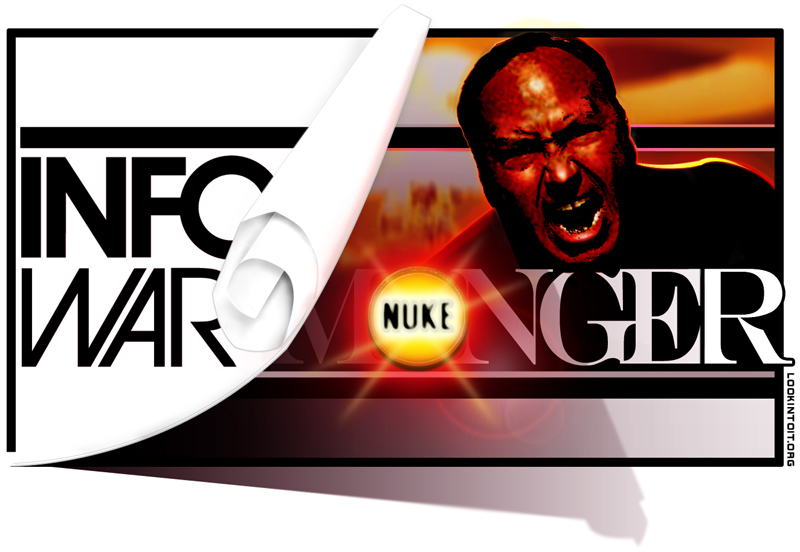
Since the time of the above report of 2010, Wayne Madsen and Alex Jones have fallen out with each other. Wayne Madsen has gone on record that Alex Jones is no longer covering the news as he had in the past, and has soldout to Trump/The Establishment. As far as I am aware, during the first year of Trump's presidency, there has been no mention of The Rand Corporation in Alex Jones' reporting (as seen above) in regard to the North Korea US conflict. I agree with Madsen; Jones selling out can not be any more obvious than his hawkish stance on foreign policy, where on his news broadcast he has recently "war gamed" a preemptive nuclear strike on North Korea that would kill one million Koreans, and ranted about striking China — which would certainly doom the entire planet! He's repeatedly had Joel Skousen on his show, who claims it is “The Deep State” that is preventing Trump from striking North Korea (a supreme psyop) and in a recent instance, exclaims that the only way to have peace with North Korea is to, "take them out". (You can watch his insane nonsense at this link: https://www.youtube.com/watch?v=QWQhxwSNWUY) Absurdly, after entertaining such Dr. Strangelove type horrors, and others that I won’t go into here, Alex Jones every now and then announces that he doesn't want war and that he's not a warmonger?!
These war maneuvers are what causes North Korea to do their missile testing, but this integral part of the narrative is left out on purpose by the CIA controlled media, and the average person ambivalently concludes that North Korea is the aggressor. Alex knows this because Paul Watson’s article is about these drills almost starting the major conflict that RAND has been waiting for to “boost the economy”. Alex suppresses this aspect, and points all the blame at North Korea. Therefore, this kind of manipulation serves to build the consensus The Establishment needs in taking the military action they had planned all along…And the public is duped yet again into supporting a war for the psychopaths that caused it!
Alex Jones is nothing more than Trump's/The Establishment’s PR stooge, whose role is (along with many other pseudo ALT-media) to project a false dichotomy of, “Trump vs The Deep State” when in fact Trump's foreign policy actions have revealed him to be its frontman, not its adversary. In my opinion, Alex Jones is able to keep this disgraceful deception going only because the majority of his viewership is either too new, or has no memory of what he has said and covered in the past. An example of his prior work condemning his present preemptive war attitude, would be his exposé on the RAND Corporation. Please investigate RAND Corp and their maniacal nuclear war plans for "The Big War" as the article above stated, plans it seems Alex Jones and this administration are all in congruence with. Go to the RAND page to see several of his videos promoting preemptive strikes. You can hear what Wayne Madsen and others had to say about Alex Jones in the Youtube Video Below: Infowars Employees Expose Alex Jones. Nuclear WAR is not to be trivialized as it has been by president Trump and news media like Alex Jones/Infowars, and should concern every person living on this planet. Do not sit idly by and allow the government or media to carelessly and irresponsibly ramp tensions, or tolerate threats about mass death as though it were just normal barbarous squalling from some ancient coliseum. Call these warmongers out because your life and all those whom you love depend on it. |
 lookintoit.org
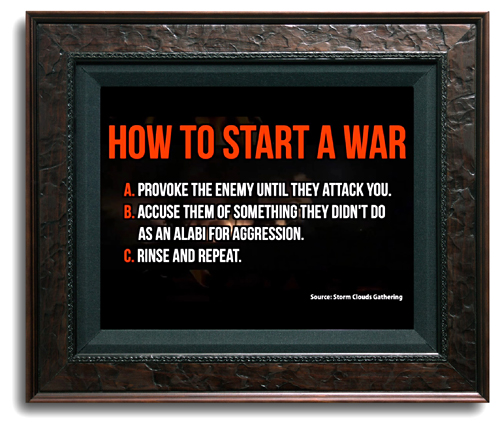 To prove that to me, it would take him reporting about the
provocative US military drills on North Korea's border - which could actually start a world
war — with at least a fraction of the coverage he gave one US military drill in Texas and a
few other states called:
To prove that to me, it would take him reporting about the
provocative US military drills on North Korea's border - which could actually start a world
war — with at least a fraction of the coverage he gave one US military drill in Texas and a
few other states called: 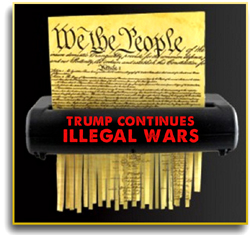 On top of this, instead of holding Trump
accountable to his sworn allegiance to the
On top of this, instead of holding Trump
accountable to his sworn allegiance to the |
Fake Alternative News Exposed! (Full Documentary) TyrannyUnmasked
Additional Information: Alex
Jones admits his family and father worked for the CIA
@28:17 "...whenever I go to a family reunion half the people in the room are former retired CIA." - Alex Jones
"If you give a man the correct information for seven years, he may believe the incorrect information on the first day of the eighth year when it is necessary, from your point of view, that he should do so. Your first job is to build the credibility and the authenticity of your propaganda, and persuade the enemy to trust you although you are his enemy." - A Psychological Warfare Casebook Operations Research Office Johns Hopkins University Baltimore (1958) Link: C.I.A. |
Infowars Employees Expose Alex Jones Know More News
Featuring: |
Alex Jones, Trump, & the False Left vs Right
Paradigm Ditch Your Box Streamed live on
I discuss the change in Alex Jones and Donald Trump from being outside the paradigm of left v right politics to now openly promoting it. We cover the false ways the war on terror is promoted via things like the refugee crisis and Islamic terror. I also talk about the use of Donald Trump as a tool to reshape American political discourse in a similar fashion to Barak Obama did with the anti-war movement and civil rights issues he vowed to stand for (but didn't). I also talk briefly about Israel and Peter Sutherland's dialog with the EU about
changing the demographics of the member states in order to fight homogeneity.
|
"...So if China keeps
pushing the only option is full commitment
to hit China preemptively."
-- Alex Jones --
 |
|
 |
|
2014 |
2017 |
|
------- 2014 -------> |
|
Caller - “It is the Military Industrial Complex, that is taken over here, and…It’s just happening, I mean and I don’t know how we’re gonna defend ourselves against it.” Jones - “No no I agree, it’s special interests on all sides that make money off conflict instead of free-market instead of real things that help people and…There was a top British analyst and government official, I forget his name, like two months ago came out and said look, our governments are creating crises to stay in power, and they're going to end up causing WW3...They’re screwing things up on purpose.”
- From Youtube Video “Growing Dangers of A New Crimean War” March 17,2014 @ 3:12 -
"If we liberated North Korea I'd kinda probably get behind it, but not if it was going to cause a Nuclear War." -- Alex Jones- From Youtube Video "Retired Intel Officer Reveals Globalists Run Agenda in Ukraine" March 17,2014 -
|
------- 2017 -------> |
|
"...The United States is preparing to Nuke China so get ready assholes!"
Alex Jones 2017, Youtube Video:
Nuclear War Imminent: US Prepares To Strike North Korean Missile Sites
! WARMONGERING
PAR EXCELLENCE !
Alex Jones Calls For Preemptive Nuclear Strikes on North Korea & China!
|
North Korea Must Be Totally Crippled In Response To Any Terrorist Acts
|
RWW News: Jones: Prepare For Nuclear War With China
|
North Korea Threat To US Will Be Met With “Massive Military Response”
|
|
|
The Alex Jones Channel Joel Skousen -- "Well the important thing to remember is that you got a war going on in the white house, of globalists, neocons trying to Keep Trump From doing an effective preemptive strike against North Korea..." [Comment] "North Korea did not make an unqualified threat to attack the US base in Guam. The mainstream media is completely twisting what was said in the North Korean statement following Trump's "fire and fury" threat. Here is what North Korea ACTUALLY said..." -- Jake Morphonious Expert: Trump Is Planning To Strike North Korea The Alex Jones Channel Joel Skousen joins Alex Jones live via Skype to make bold predictions as to President Trump's plans for dealing with the North Korean regime, but it will wait until after the Winter Olympics.
|
RWW News: Jones: Prepare For Nuclear War With China "Those crazy people have proven they will go to war. They're completely psycho like Kim Jung Un on power trips. So if China keeps pushing the only option is full commitment to hit China preemptively. That's the only way to survive this nuclear war and Trump knows it." "...The United States in preparing to Nuke China so get ready assholes!" -- Alex Jones
Nuclear War Imminent: US Prepares To Strike North Korean Missile Sites The Alex Jones Channel Bannon removed from Security council, And China through North Korea is rattling sabres at the USA. The world is in crisis and on the brink of nuclear war. RED ALERT! War With North Korea Has Never Been Closer The Alex Jones Channel
|
The Alex Jones Channel “We are not looking to the total annihilation of a country, namely North Korea,” said James Mattis, speaking outside the White House, but “we have many options to do so”. www.theguardian.com/world/201... "If we don't hit them first, who
knows what will happen it will continue geting worse with the mental illness and the megalomania,
there is no good choice. If you hit them conventionally, they're not going to back off. They're not
going to sue for peace, they're going to attack with everything they've got, Japan and South Korea,
and have a bunch of people run to the north as refugees that are already trying to get out, it's
gonna be a giant quagmire. If you hit them with total commitment...you will defeat the communist
regime, you'll kill probably a Million People, and
then you can try and reunify and deprogram the population. If China and Russia standdown. If China
and Russia don't standdown we go into total worldwide thermal nuclear world war 3." -- Alex
Jones Joel Skousen: Only Way To Have Peace In North Korea Is To Take Them Out
The Alex Jones Channel Alex Jones talks with Joel Skousen about what he thinks will happen and how we need to handle North Korea |
|
The article link below gives a facetious yet valid quick solution to which I would add Alex Jones, and "The Naked Warmonger" Joel Skousen to join in the move with super warhawk Graham. Be sure to scroll down this page and see Infowars' report on missing nukes and Graham.
|

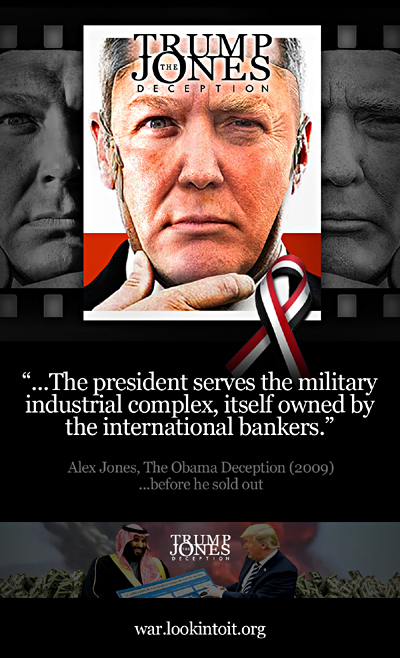
"...The United States is
preparing to Nuke China so get ready assholes!"
-- Alex Jones --

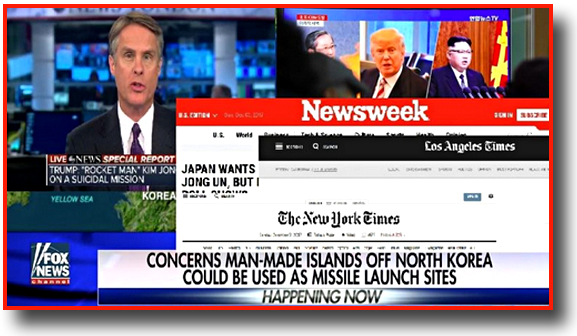
Media Complicity Increases
The Possibility Of A New
Korean War
By Martin Hart-Landsberg
December 3, 2017
Tensions between the US and North Korea are again rising in the wake of North Korea’s November 28th test of an ICBM that experts believe has the potential to deliver a nuclear bomb to cities on the east coast of the US, including Washington D.C.
As I have written before, we desperately need to change US foreign policy towards North Korea. North Korea’s leaders continue to seek talks with the United States, with all issues on the table, those of concern to them and those of concern to the US government. But the US government continues to refuse. The Trump administration has even rejected North Korean offers to freeze its production and testing of missiles and nuclear weapons in return for a halt to US war games directed against North Korea.
Instead, Trump continues Obama’s strategy of responding to every North Korean missile launch or nuclear test with new military threats and sanctions.
Unfortunately, changing US foreign policy towards North Korea is no easy matter. One reason is that there are powerful forces opposing a de-escalation of tensions. Sadly, the tension is useful to the US military industrial complex, which needs enemies to support its desire increase in the military budget. It is also useful to the US military, providing it with a justification for maintaining troops on the Asian mainland and in Japan. The tension also helps the US government isolate China and boost right-wing political tendencies in Japan and South Korea, developments favorable to our own militarists and right-wingers. Of course, the costs of US policy fall on ordinary people.
Another reason for the difficulty in changing US policy towards North Korea is that the US media does little to provide the context necessary for people in the United States to understand its lawless and destructive nature.
The illegality of Trump administration threats of destruction
The Trump administration has repeatedly threatened North Korea with total destruction. What is missing from media accounts of these threats is the explanation that they represent a violation of the UN Charter and international law. As Gavan McCormack explains:
According to the UN Charter’s Article 2 (3), disputes between states must be settled by peaceful means and (4) “All members shall refrain in their international relations from the threat or use of force against the territorial integrity or political independence of any state …” [italics added]. Article 33 further specifies the obligation of parties to any dispute likely to endanger international peace and security to “first of all, seek a solution by negotiation inquiry, mediation, conciliation … or other peaceful means of their own choice.” By ruling out negotiations with North Korea and insisting only on submission, the US, Japan and Australia ignore or breach this clear rule (and Japan breaches also the proscription on the “threat or use of force as means of settling international disputes” in its own constitution). Going beyond that, President Trump has also not only insulted the North Korean leader from the platform of the UN General Assembly but actually threatened his country with “total destruction,” by “fire and fury, and frankly power the likes of which this world has never seen before.” That surely qualifies as threat. It is even genocidal, and therefore criminal behavior, not only on the part of those (Trump) who utter it but on the part also of those like Abe and Turnbull (to whom perhaps now India’s Modi is to be added) who endorse and encourage it.
Moreover, in 1996, the International Court of Justice, in response to a UN request, ruled that threats to use nuclear weapons against another country are a violation of international law except “in an extreme circumstance of self-defense, in which the very survival of a State would be at stake.” In certainly seems clear that the US is in violation of international law because of its repeated threats and military exercises designed to practice a nuclear attack on North Korea.
Tragically, the US media has remained silent about this lawlessness on the part of the US government.
The illegality of US-initiated UN sanctions on North Korea
The US has aggressively pursued the adoption of UN sanctions on North Korea. The ones adopted in August and September are the most sweeping yet. They call for blocking North Korean exports of coal, iron, iron ore, lead, lead ore, seafood and textiles, all of which are important earners of foreign exchange. The resolutions also ban countries from opening new or expanding existing joint ventures in North Korea or renewing labor export agreements. They also impose a cap on the amount of oil North Korea is allowed to import and call for a total ban on the country’s import of natural gas and condensates. If rigorously enforced these sanctions will devastate living conditions for the great majority of North Koreans.
However, sanctions that target an entire population with the aim of causing economic collapse, such as those being imposed on North Korea, are illegal under the UN charter. As McCormack points out:
Only sanctions carefully tailored to apply to those who act in the name of the government and bear responsibility for its offensive actions may be legitimate. . . . The point is clear that that those imposing sanctions bear an obligation to ensure they impact only upon those who are in a position of power, not on innocent civilians. There is reason to wonder if the United Nations itself, by the ordering of collective punishment of the entire North Korean people for offenses committed by their government, may be acting criminally.
Again, where are the stories pointing out the lawlessness of US and UN actions?
[quote emphasis added]
"North Korea’s leaders continue to seek talks with the United States, with all issues on the table, those of concern to them and those of concern to the US government. But the US government continues to refuse. The Trump administration has even rejected North Korean offers to freeze its production and testing of missiles and nuclear weapons in return for a halt to US war games directed against North Korea."
The missing explanation of North Korean responses to US policy
The reporting on North Korea’s November 28th ICBM test offers another example of the US media’s failure to educate its readers. For example, here is the LA Times:
The launch is North Korea’s first since it fired an intermediate-range missile over Japan on Sept. 15, and may have broken any efforts at diplomacy meant to end the North’s nuclear ambitions. U.S. officials have sporadically floated the idea of direct talks with North Korea if it maintained restraint. . . .
Italy’s U.N. Ambassador Sebastiano Cardi, the current Security Council president, told reporters late Tuesday that “it’s certainly very worrying. Everybody was hoping that there would be restraint from the regime.”
This reporting certainly suggests that North Korea just doesn’t want peace no matter how hard the US and broader international community try. But the story changes if we provide some missing context.
Since 2013 North Korea has offered to halt its testing of missiles and nuclear weapons if the US would halt its war games. The US organizes two different annual war games in South Korea, the first is held over March and April and the second is in August. But from time to time, it also engages in other smaller military exercises on and near the Korean peninsula.
The August 2017 war games included planning for a nuclear attack and “decapitation” of North Korea’s leadership. These August war games are smaller than the March-April ones but still large. This one included some 20,000 US and 50,000 South Korean troops. And this year, for the first time, they were combined with a separate 18 day live-fire exercise involving US and Japanese forces on the northern Japanese island of Hokkaido.
North Korea responded to these threatening maneuvers by first firing a missile over Hokkaido on August 29, the day after the completion of the US-led exercises. Then on September 3, it conducted its sixth and largest test of a nuclear weapon. And finally, on September 15, it tested a new intermediate-range missile to demonstrate its ability to hit the major US air base in Guam.
There are 75 days from September 15 to November 28; this is an important interval. The reason is that the US had publicly called upon North Korea to halt its missile testing for at least 60 days to show its good will.
For example, in August, Secretary of State Rex Tillerson told a group of reporters that “The best signal that North Korea could give us that they’re prepared to talk would be to stop these missile launches . . . We’ve not had an extended period of time where they have not taken some type of provocative action by launching ballistic missiles. So I think that would be the first and strongest signal they could send us is just stop, stop these missile launches.” And in October, Joseph Yun, the U.S. State Department’s top official on North Korea policy, told an audience at the Council on Foreign Relations “that if North Korea halted nuclear and missile testing for about 60 days, that would be the signal the United States needs to resume direct dialogue with Pyongyang.”
As we have seen, the North Koreans did refrain from missile launches and weapon tests for more than 60 days. But, what did the US do during that time to encourage North Korea?
On September 23 the Pentagon sent B-1B Lancer bombers, nicknamed “the swan of death,” to fly over international airspace just off the coast of North Korea, the first time since the Korean War that a U.S. bomber flew over North Korea’s east coast.
Then for five days, starting October 16, the US conducted joint naval exercises with South Korea that included the nuclear aircraft carrier Ronald Reagan, three nuclear submarines, Aegis destroyers and more than 40 other battleships and numerous fighter aircraft.
In November, the US conducted more navel drills. This time it was a four-day exercise involving three aircraft carriers–the USS Ronald Reagan, Theodore Roosevelt and Nimitz–and their multiship strike groups in the waters between South Korea and Japan. This was the first time all three aircraft carriers were together in the Western Pacific in a decade. South Korean and Japanese warships also participated in the exercise.
Also in November, President Trump placed North Korea back on the list of state sponsors of terrorism, which meant new sanctions. And finally, again in November, the US announced yet another war game to be scheduled for the period December 4-8 involving US, Japanese, and South Korean forces. Called Vigilant Ace, the military announced that this exercise would include “enemy infiltration” and “precision strike drills” and involve 8 air bases, 12,000 soldiers, and 280 aircraft, including the two stealth fighters, the F-22 and the F-35. This was to be the first time that the F-22 and F-35 would be used in war games on the Korean peninsula.
So, after waiting 75 days, and observing US actions, all of which were hostile, North Korea not surprisingly responded with the launch of its most powerful ICBM, showing the US that it could target even its capital if attacked. But by presenting this missile launch without the appropriate context the media made it appear as just another example of North Korea’s recklessness and hostility.
Sadly, we have a lot of work to do.
Article Link:
http://kpolicy.org/media-complicity-increases-the-possibility-of-a-new-korean-war/


"Our Job Is to Scare People to Death Over North Korea"
- Brian Williams, MSM Hack -
Only Morons Believe What The US Government Says About North Korea
Usually foreign analysts of the American
political scene are either sycophantic or just annoying, but no one would dare say that about Aussie observer
Caitlin Johnstone, whose punk rock style of cutting to the chase is as refreshing as it can be shocking (I am not a
fan of the strong language, but I get it). Since President Trump's "fire and fury" explosion yesterday Americans
have to an unsettling degree once again rallied 'round the (false) flag of war propaganda. Today Ms. Johnstone
provided a much-needed slap in the face to the mind-numbed masses once again clamoring for US bombs on a country
they could not find on a map if their lives
depended on it.
As even many soi-disant libertarians reverted back to playing war commander on their keyboards --
"I'm all for a non-interventionist foreign policy, but THIS GUY'S GONNA KILL US!!!" -- Johnstone reminded anyone
with half a brain of one eternal truth: Governments and their house servants (the mainstream media, neocons, deep
state, etc) are murderous liars and the only way they dare flush a few hundred billion dollars -- and oceans of
blood -- down the toilet of war is to first lie their brains out to the people they are confident will swallow the
poison pills and call them candy.
Of course the United States government and its minions are lying about North Korea, Johnstone reminds us. They
ALWAYS lie!
She writes:
The United States power establishment has an extensive history of using lies, false flags and propaganda to manipulate its hundreds of millions of citizens into supporting needless military interventionism. From the Gulf of Tonkin incident to the false Nayirah testimony to the amazing network of lies spun about Saddam Hussein to the 'humanitarian' intervention in Libya to the unconscionable Bana Alabed psy-op in Syria, there is no depth to which the US war machine will not stoop in deceiving the public about the need to unload the military-industrial complex’s expensive inventory onto some third world country overseas, no limit to the evils that America’s unelected power establishment will commit in order to secure geopolitical dominance, and no end to the mass media propaganda machine’s willingness to report war propaganda as objective fact.
It is quite literally impossible to be too paranoid about these people. If you had an acquaintance who was a known compulsive liar with an extensive history of duping people into fighting one another for his own sociopathic amusement, how would you react if he handed you a gun and told you that your neighbor is getting ready to attack you?
This might prove shocking even to some "libertarians" caught up in the frenzy of manufactured
threats. But the US government lies. They lie day and night. All the time about everything.
Johnstone concludes:
There is one government in the mix here that has proven itself completely sociopathic and untrustworthy in such matters, and it ain’t the DPRK. Stay skeptical, stay watchful, and stay woke.
"Oh no," people squeal! "THIS time they're telling the truth!"
Good luck with that. Blood's on your hands, not ours.

Beware of both MSM & ALT-Media
|
"The globalists create confusion by design
so that people see a smokescreen and can't figure out what's going on and that they hope would
just roll over and give up." |
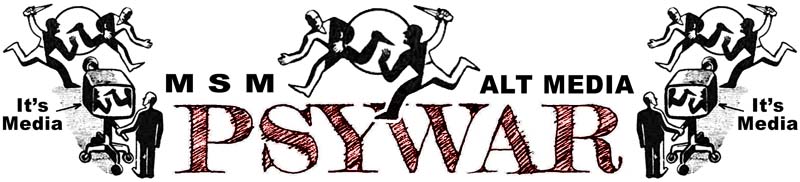
Adaptation and
Conformity
The Selling Out of Alex Jones/Infowars
Link: Psywars
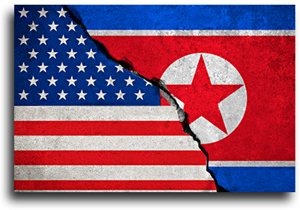
Amy Goodman: "How close do you think the U.S. is to nuclear war with North Korea, Professor Cumings?"
| “W |
A nuclear war between North Korea and the United States would devastate the region. But more than that, it would probably lead to at least two years of nuclear winter, where the debris swirling around the planet and the atmosphere would make it impossible to grow crops. Anyone who talks about nuclear war in this day and age, with all we know about nuclear winter and the terrible effects of nuclear weapons, is basically a war criminal, in my view. Nuclear weapons should never be used. And especially to see a president of United States go to the United Nations and threaten to totally destroy North Korea, I mean, that was just nauseating. And one thing he forgot, since he knows no history, is we already did that during the Korean War. We razed every North Korean city to the ground with firebombing and incendiaries. And it still didn’t work. They still fought us to a stalemate. There’s no military solution in Korea. We should have recognized that in 1953. |
- Bruce Cumings, Chairman of the Department of History at the University of Chicago -
The Following Are Underreported Essential Points To The Conflict:
-
North Korea has been under nuclear threat since the Korean War. Our war plans for decades called for using nuclear weapons very early in a new war. That’s one reason there hasn’t been a new war , but every general prepares for the worse case. And so North Korea has essentially spent about fifty or sixty years developing the only deterrent to nuclear weapons that they possibly can, until they got their own nuclear weapons in the last two years. [Lawrence Velvel] Do you think most Americans know that we had nuclear weapons in South Korea as early as, well in 1958 or so? [B.C.] That’s something that is very mystified. I’ve tried to bring it out time and time again in articles, but I went to the Eisenhower library and looked at the documents on it. We put ‘Honest John’ missiles - nuclear tipped - into South Korea in 1958. The decision was made in 1957 by John Foster Dulles. And you look at the National Security Council’s records, they know they’re violating a cardinal principle of the armistice that ended the Korean War : which is not to introduce new and different quality weapons. It’s said, ’Well you know they’re always doing that, they’re bringing in new MIGs and everything, so we can do this. But I mean to go from conventional weapons to nuclear weapons essentially obliterated that article of the [Armistice]. [L.V.] Yeah that’s taken as these days, that is the line…that is the line. [B.C.] They were there in the hundreds in the 70’s and 80’s. [L.V.] In the hundreds?! [B.C.] Yeah hundreds, because they started with bringing in tactical nuclear weapons like nuclear mines that you could fit in a backpack. Soldier in a jeep goes up to the DMZ and puts one down…In the 80’s a lot of this came out because our own military didn’t like it. I heard a retired general give a lecture at Carnegie Endowment where he said, ‘we done things like put a nuclear weapon on a helicopter., and then it goes up near the DMZ, and what if it is, you know, somehow captured by the North Koreans or gets off course.’ He said, “We relied way too much on a nuclear deterrent to the point the South Korean army doesn’t think it has to fight in a new war because we are going to wipeout the North Koreans.” -- Bruce Cuming & Lawrence Velvel
-
“…The United States in the region has a central objective that does not concern Kim Jong-un or his nuclear weapons. Rather, it is driven by the perennial necessity to increase forces in the region for the purposes of maintaining a balance of military force (Asian Pivot) and ultimately trying to contain the rise of the People’s Republic of China (PRC).” -- Federico Pieraccini
-
“…Think about this, if they [The C.I.A] thought that Kim Jong Un was getting ready to nuke American citizens, they could assassinate this guy within 24 hours. They could knock him off like that, his government would crumble. The problem with that though, is that the C.I.A. would not have control of the process of the rebuilding of the North Korean government. What they want is total control. What they are doing is trying to arrange a full scale military operation like what we did in Iraq. That way we’d get in, we’d control the infrastructure, we’d control the setting up of the new government and we’d install a puppet. An entire puppet government, that’s what we did in Iran, and Afghanistan. And this includes controlling the policies of the new government in a way that favors the United States, and includes new U.S. military outposts being setup in North Korea. Of course that’s something that China and Russia are not going to sit by and just allow to happen….There are mutually beneficially things that can be determined here [between US and NK] , but unless the two sides sit down and talk, nothing is going to happen, and that is the actual goal of the C.I.A. They don‘t want there to be negotiations. They want what they want. The globalists do not want compromise, they are after control. And they are not going to get control as long as Kim is in power; he‘s too independent. The Kim dynasty , they don‘t go along with what the C.I.A. tells them to do…And that is why I believe that there is not going to be a Donald Trump negotiation to resolve this conflict.
I think that the deep state is going to push and push and push; they will create a false flag attack if necessary, something will happen to make it look like we absolutely have to go to war with North Korea…This is not a simple issue. This is certainly not a story of just some crazy little dictator who is off his rocker and he wants to control the world; he wants to develop nuclear weapons and destroy everyone. This is not Dr Evil, this is a puny little guy who was thrust into a position well before he was ready for it, who is scared to death, doesn’t know what to do. But all he knows is the C.I.A. is going to murder him if he gives them the chance. ” -- Jake Morphonios
-
“The US ‘War Economy’. One can also argue there are very powerful vested interests in the US corporate structure who have, and will continue to benefit from a heated arms build-up, and will certainly use the North Korea threat as a justification to push forward spending, especially in light of Washington’s new found austerity culture ushered in through recent budget sequestrations. America’s new pivot towards Asia provides the catch-all policy net, while the two-way propaganda duel between the two countries provides the fear needed to justify a new military build up in the region.”
“By now, we should all have learned the lesson: mainstream media, not politics, is the true engine of war.” -- Patrick Henningsen
-
In response to the recent U.N. Security Council vote, North Korea’s government stated that it would not negotiate over its nuclear or missile programs. The assumption that seems to be behind Trump administration policy is that they can be cajoled into doing this, and furthermore that they can be pressured into making concessions on these issues before talks begin. The administration is laboring under the delusion that it is still possible to persuade North Korea to give up on things that its government considers essential to its security. If anything, the heightened tensions and increased pressure in recent months have just confirmed their leadership in the belief that they need their nuclear weapons and missiles more than ever. Needless to say, talking about raining down “fire and fury” on them isn’t going to make them more likely to compromise on this point.
One of the more common hawkish refrains about North Korea is that “diplomacy has been tried and it failed,” but this ignores that North Korea acquired nuclear weapons in response to some of the same pressure tactics that hawks wanted to use in lieu of the nuclear deal with Iran. There was a diplomatic agreement in place that had succeeded in limiting North Korea’s nuclear program, but the Bush administration wasn’t satisfied with it. They blew up the agreement, and North Korea withdrew from the NPT and tested its first nuclear weapon soon thereafter. North Korea is a cautionary tale about what happens when hard-liners in Washington prefer to scrap an imperfect but working nonproliferation agreement in favor of pursuing the fantasy of forcing the other side’s total capitulation. -- Daniel Larison
-
“Talk of war is dangerous and irresponsible. It would have catastrophic consequences for Northeast Asia and the world. Military action could slow the North’s program, but not eliminate it. Threats of war, moreover, only make the North redouble efforts to hold the United States at risk. And they greatly exacerbate the greatest risk of all: an inadvertent war on the Korean peninsula with the potential for hundreds of thousands of deaths, including thousands of American citizens. Unfortunately, some American leaders believe that if there is a war, keeping it on the Korean peninsula will keep us safe. I maintain that a nuclear war anywhere will have catastrophic consequences for America.” -- Siegfried S. Hecker
- "The reason that George Bush was so intent on screwing up the [94Carter/Clinton] deal. Was because when he
took power, the Japanese and South Koreans were basically already ignoring the Americans and had their own
North Korea policy at that point. And really wanted to push The Sunshine policy, they called it, toward
reunification in slow motion, but still toward peace, toward understanding… families aloud to visit back and
forth across the border…Trains that run back and forth so that you could have multinational businesses on both
sides of the border…begin to forge these relationships, and thought-out the crisis. And to the Bush regime that
was absolutely intolerable. That our Japanese and South Korean satellites would think that they can have their
own foreign policy on North Korea issues. And that is why they really moved to quash it…
And that goes to show that the American government’s interest in Korea is not peace. The American government’s interest in Korea is to keep them divided, because the Pacific is an American lake. And a big part of the reason that the Japanese rely on us, is because they’ve got that North Korean problem to deal with etc. etc…We keep them divided, we keep them conquered, we keep them our satellites. If we can tell the Japanese, ‘you shut up we’ll take care of it’ then we can keep them quiet. If we can’t credibly say that we are in charge of the situation, then they’re going to go ahead and make their own policy. So the American policy is that we prefer a divided Korea that could explode into nuclear warfare, rather than sunshine and peace, and globetrotters and gymnastics and symphony orchestras, and a future that anyone would want to look forward to. So that’s where your government is coming from on this. They are evil. And they are refusing to solve a problem that is really pretty simple to solve…At least for a beginning." -- Scott Horton
- The North Koreans want peace. They want a formal end to the war and they want guarantees that the United
States won’t preemptively attack them. Is that too much to ask?
But the United States won’t sign a treaty with the North because it is not in its interests to do so. Washington would prefer for things to stay just the way they are today. In fact, Hillary Clinton said as much in a speech she made to Goldman Sachs in 2013. Here’s an excerpt:
CLINTON: “We don’t want a unified Korean peninsula, because if there were one South Korea would be dominant for the obvious economic and political reasons.-We [also] don’t want the North Koreans to cause more trouble than the system can absorb. So we’ve got a pretty good thing going with the previous North Korean leaders [Kim Il-sung and Kim Jung-il]. And then along comes the new young leader [Kim Jung-un], and he proceeds to insult the Chinese. He refuses to accept delegations coming from them…..So the new [Chinese] leadership basically calls him [Kim Jung-un] on the carpet. …Cut it out. Just stop it. Who do you think you are? You are dependent on us [the Chinese], and you know it. (WikiLeaks)
There it is in black and white. The US does not want a unified Korea. (“for obvious economic and political reasons.”) The US wants to keep the country split up so it can keep the North isolated and underdeveloped, maintain the South’s colonial dependence on the US, and perpetuate the occupation. That’s what Washington wants. The goal is not security, but power, greed and geopolitical positioning.
From Washington’s point of view, the status quo is just dandy which is why there is no incentive to end the war, sign a treaty, wind down the occupation, or provide security guarantees for the North. As Hillary cheerily opines, “We’ve got a pretty good thing going on.” -- Mike Whitney
-----------Sources:
Bruce Cumings
The Korean War: A History
Interview at Massachusetts School of Law at Andover [video] - Published on Mar 23, 2011
Federico Pieraccini
Avoiding Nuclear War: Why Kim Jong-Un’s Strategy Makes Sense - August 11, 2017
https://www.globalresearch.ca/avoiding-nuclear-war-why-kim-jong-uns-strategy-makes-sense/5603657
Jake Morphonios
The North Korea "Crisis" is a CIA Operation On Behalf of New World Order
Globalists [video] - Published circa Aug 21, 2017
Patrick Henningsen
North Korea: Beyond the cold war theatrics, is there really a nuclear threat to US? - April 6, 2013
Daniel Larison
North Korea and the Nuclear Deal - August 10, 2017, 8:47 AM
http://www.theamericanconservative.com/larison/north-korea-and-the-nuclear-deal/
Siegfried S. Hecker
Hecker: Talk to North Korea to avert a nuclear disaster - August 7, 2017
https://fsi.stanford.edu/news/hecker-how-deal-north-korea
Scott Horton
Scott Horton speech on North Korea and Iran [video] - Published on Jun 11, 2013
Angelo State University in San Angelo, Texas, April 24, 2013
Mike Whitney
Why Can’t Wheeler-Dealer Trump Cut a Deal with North Korea? - August 26, 2017
http://www.globalresearch.ca/why-cant-wheeler-dealer-trump-cut-a-deal-with-north-korea/5605790
* More essential background information can be found on the Home
Page of this site *
Color footage of Atomic Bomb tests in Nevada
- Soldiers being exposed to high levels of radiation -
Let this footage be a vivid reminder that certain people on this planet care nothing about it, nor their fellow man. If the "US government" would do this to its own troops of the "indispensable and exceptional nation because of its values", can you imagine what these types of people are doing and have planned for the world? ...Speakout, educate others, and do not tolerate or support those who'd talk about nuking nations as an option to solve the tensions that exist between them.
LINK: U.S. Military Killing Its Own Troops!
“Wipe the Soviet Union Off the
Map”:
Planned US Nuclear Attack against USSR
South Front
Published on Dec 2, 2017
Based on the research of Prof. Michel Chossudovsky, Centre for Research on Globalization (CRG) https://www.globalresearch.ca/wipe-th...
If you’re able, and if you like our content and approach, please support the project. Our work wouldn’t be possible without your help: PayPal: [email protected], http://southfront.org/donate/ or via: https://www.patreon.com/southfront
Crosstalk: Dr Strangelove’s World
RT
Published on Feb 9, 2018
The Pentagon recently released its new Nuclear Posture Review. Its critics are stunned. Not only
the use of nuclear weapons is now more thinkable, but the threshold for their use has been lowered. Doctor
Strangelove would be proud.
Is the world facing another dangerous arms race?
CrossTalking with Michael O'Hanlon, Kevin Kamps, and Adriel Kasonta.
Who Let Dr. Strangelove Write The Pentagon's Nuclear Posture Review?
by Tyler Durden
Sun, 2/4/2018
Authored by Julia Conley via TheAntiMedia.org,
The Pentagon’s official outline for its use of nuclear force was denounced as “radical” and “extreme” by prominent anti-nuclear weapons groups when it was released Friday afternoon—confirming peace advocates’ worst fears that the Trump administration would seek to expand the use of nuclear force.
“Who in their right mind thinks we should expand the list of scenarios in which we might launch nuclear weapons?” asked Peace Action in a statement.
“Who let Dr. Strangelove write the Nuclear Posture Review?”
The Nuclear Posture Review (NPR) calls for the development of smaller warheads that the military believes would be seen as more “usable” against other nations.
“In support of a strong and credible nuclear deterrent, the United States must…maintain a nuclear force with a diverse, flexible range of nuclear yield and delivery modes that are ready, capable, and credible,” reads the report, which serves as the first updated document the U.S. has released regarding its perceived nuclear threats since 2010.
In addition to “diversifying” its nuclear arsenal, the Pentagon notes that it will seek to “expand the range of credible U.S. options for responding to nuclear or non-nuclear strategic attack,” raising concerns that President Donald Trump will argue for the use of nuclear force as a deterrent—a significant departure from previous administrations which saw nuclear weapons as an option only for retaliation.
“The risk of use for nuclear weapons has always been unacceptably high,” said Beatrice Fihn, executive director of the International Campaign to Abolish Nuclear Weapons (ICAN).
“The new Trump Nuclear Doctrine is to deliberately increase that risk. It is an all-out attempt to take nuclear weapons out of the silos and onto the battlefield. This policy is a shift from one where the use of nuclear weapons is possible to one where the use of nuclear weapons is likely.”
Derek Johnson, head of Global Zero, called the NPR “a radical plan written by extreme elements and nuclear ideologues in Trump’s inner circle who believe nuclear weapons are a wonder drug that can solve our national security challenges.”
“Trump’s insistence that we need more and better weapons is already spurring countries to follow in his footsteps,” he added. “Nuclear arms-racing is a steep and slippery slope; we’d do well to learn the lessons of the former Soviet Union, whose collapse was accelerated by its unsustainable nuclear ambitions.”
As Paul Craig Roberts summed up so eloquently, the new US nuclear posture is a reckless, irresponsible, and destabilizing departure from the previous attitude toward nuclear weapons. The use of even a small part of the existing arsenal of the United States would be sufficient to destroy life on earth. Yet, the posture review calls for more weapons, speaks of nuclear weapons as “usable,” and justifies their use in First Strikes even against countries that do not have nuclear weapons.
This is an insane escalation. It tells every country that the US government believes in the first use of nuclear weapons against any and every country. Nuclear powers such as Russia and China must see this to be a massive increase in the threat level from the United States. Those responsible for this document should be committed to insane aslyums, not left in policy positions where they can put it into action.

The Road to Nuclear War with China Runs Through Taiwan
Newsbud
Published on Feb 7, 2018
Nukes are coming back to Asia!
America’s Nuclear Posture Review is out, and it offers a blueprint for a nuclear war with China. China’s not gonna
like it, you’re not gonna like it, but it’s the Pentagon’s miracle cure for declining US conventional strength in
Asia.
It’s another sign that the uniformed military, its anxieties, and its priorities are at the heart of US foreign
policy. The acronyms you want to watch for are SLCS, LRSO, and B O O M. The powderkeg you want to keep your eye on
is Taiwan, where it looks like the hegemon hopes and nuclear fantasies of the China hawks are going to collide.
See Full Video Here: http://bit.ly/2nOw6kg
Now available for rent at: http://bit.ly/2sjvxEK

Articles:
|
CLICK IMAGE
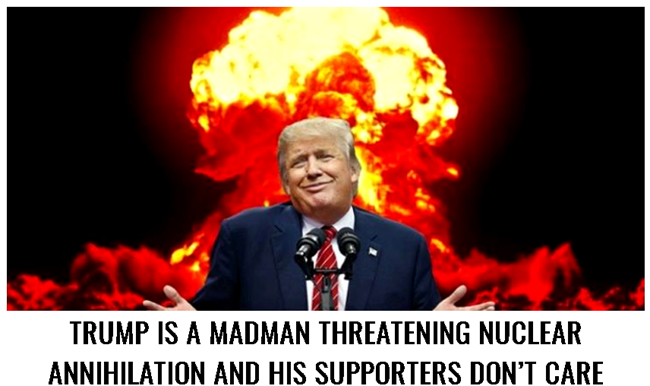
http://theantimedia.org/trump-threatening-nuclear-annihilation/
Chilling Survey Reveals Majority of Americans Willing To
Preemptively Nuke
Other Nations
http://theantimedia.org/survey-americans-preemptively-nuke-nations/
August 31, 2017
(ANTIMEDIA) — A new survey published by the Massachusetts Institute of Technology (MIT) suggests Americans are willing to make a first nuclear strike against Iran and kill millions of civilians in the process.
However, the new survey shows that many Americans continue to support nuclear warfare when posed with a hypothetical (albeit currently nonexistent) threat. As the survey notes, a clear majority of Americans “would approve of using nuclear weapons first against the civilian population of a nonnuclear-armed adversary, killing 2 million Iranian civilians, if they believed that such use would save the lives of 20,000 U.S. soldiers.”
Around 60 percent of respondents polled said they would approve of the decision to kill two million Iranians.
As Bloomberg tragically explained:
“The survey casts doubt on the power of what experts call the ‘nuclear taboo,’ said Stanford University historian David Holloway, author of ‘Stalin and the Bomb.”’ The idea, or hope, behind the concept is that it’s not just luck that humans haven’t dropped any nuclear weapons for 70 years — that there’s a stigma that makes the use of nuclear weapons unthinkable.”
One would have to wonder if most Americans are even aware that the Trump administration is spending billions of dollars developing its nuclear technology far beyond what America’s rivals can match. Recognizing the nuclear threat America poses to Russia and its interests, particularly by having NATO members surround Russia with its anti-missile defense system, Russian President Vladimir Putin issued a warning last year that Russia was modernizing its missile systems in preparation for what’s to come.
Russia has also warned multiple times about attacking Iran and views Iran as a strategic ally. This is just one of the factors Americans should take into account when considering the use of nuclear weapons.
As Bloomberg noted, there are a number of other factors that should also be examined:
“‘That just means they haven’t thought about it,’ said Brian Toon, a professor of atmospheric science at the University of Colorado. They think nuclear weapons are just big bombs that blow up lots of people, he said, without considering the way a nuclear conflict -– even a ‘small’ one involving some 10 percent of the U.S. arsenal — might poison millions of men, women and children and change the climate enough to starve hundreds of millions.”
What it ultimately shows is that Americans want to fight (and instigate) wars but no longer want to expend their own people commissioning such conflicts. Polls have also demonstrated that the majority of Americans approve of the use of drone warfare against suspected terrorists, another example of Americans approving of killing people without realistically endangering personnel.
In Libya, an American drone flown out of Sicily by an American pilot based in Nevada directly struck Muammar Gaddafi’s motorcade. Little thought is paid to the fact that the U.S. helped assassinate a foreign leader in direct contravention of international law, arguably because no American personnel were killed or even endangered (in contrast, when many Americans think of Libya, they focus on the handful of American lives lost in Benghazi).
This paradigm, identified as one of three schools of thought by the MIT study, is solely concerned with “winning wars and the desire to minimize the loss of lives of their nation’s soldiers.”
This view appeared to hold even when the scenario presented to the respondents was one in which the U.S. aggravated Iran via sanctions and Iran responded with a direct attack on a U.S. aircraft carrier in the Persian Gulf. The Japanese attack on Pearl Harbor in 1941 was also provoked via U.S.-led crippling economic restrictions on Japan, and even the number of military personnel killed in the hypothetical scenario MIT presented to subjects was the same as the number of U.S. personnel who died at Pearl Harbor (though this was not mentioned to respondents).
As we all know, this particular story ended with the complete destruction of Japan’s major cities through conventional bombing, as well as the nuclear decimation of two civilian populations. Also bear in mind that America’s modern day nukes are far more dangerous than the bombs dropped on Hiroshima and Nagasaki, meaning any future nuclear strike would have an even worse impact on the civilian population.
In addition to a majority of Americans’ willingness to use nuclear weapons on civilians, the survey found “an even larger percentage of Americans would approve of a conventional bombing attack designed to kill 100,000 Iranian civilians in the effort to intimidate Iran into surrendering.”
...That's because Americans are being propagandized, socially engineered,
brainwashed and dumbed-down!
|
Did You Hear We NUKED China Last Week?
Mark Dice Did you hear about the nuclear war between Russia and China? Of course not, because
it didn't happen, but someone should tell that to these people! Man on the Street with Mark
Dice. |
Liberals Call to NUKE North Korea! Preemptive Nuclear Strike APPROVED in Shocking Experiment
Mark Dice
|
Russia NUKED by America!!! - Citizens React to this Earth-Shattering News
Mark Dice
|
|
Liberals Sign Petition to NUKE RUSSIA so America will Stay World's Superpower Mark Dice Media analyst Mark Dice asked beachgoers in San Diego, California to sign a petition supporting President Obama's supposed plan to launch a preemptive nuclear attack against Russia to help keep the United States of America the world's leading superpower. The results are disturbing. |
Meet Edward Bernays, Master of Propaganda Corbett Report Extras
Description:You’ve heard of his uncle Sigmund, so how come you’ve never heard of him? This week, we dish the dirt on Freud’s American nephew, the man who literally wrote the book on propaganda, and paved the way for women’s smoking, fluoride poisoning our water supply and the invasion of Guatemala, among other masterful acts of PR |
Liberals Sign Petition to NUKE CHINA in Response to Hacking of U.S. Computers!!!
Media analyst Mark Dice asked beachgoers in San Diego, California to sign a petition supporting President Obama's supposed plan to launch a nuclear attack against China as a response to Chinese hackers allegedly breaking into U.S. government computers. The results are extremely disturbing. |

Propaganda
For WAR/Nuclear WAR
|
Top 5 - Nukes in gaming
ZoominGames Blowing up virtual stuff is great but only a few games let you play with the immensely devastating nuclear bomb. So let’s see which games capture this awe-inspiring moment the best. Put on your hazmat suit and get ready for our top 5 nuclear bombs in gaming! |
10 Best Games That Let You Nuke the World FragHero Unleashing one of the most devastating effects over a large area of land, nuclear weapons have always been a thing of both wonder and terror. Their immense power fascinated gamers so much that they immediately wanted to get their hands on games that would allow them to use these. |
Modern Warfare Remastered - Nuke Scene Generic Gaming Call of Duty Modern Warfare Remastered Nuke Scene. From the missions, Shock and Awe and Aftermath. Modern Warfare Nuke Scene. Nuclear Bomb. |
ZoominGames
Published on Aug 22, 2016
Blowing up virtual stuff is great but only a few games let you play with the immensely devastating nuclear bomb. So let’s see which games capture this awe-inspiring moment the best. Put on
your hazmat suit and get ready for our top 5 nuclear bombs in gaming!
5. Command & Conquer
Most RTS games always have some sort of super weapon that you can aspire to create and Command & Conquer was no different. There was always this moment where you were looking at the nuke
and thinking to yourself, “Do I want this weapon? Will it even be fair to the other players? Will I feel guilty using it on my enemies?” The answers to these questions: hell yes!
4. Call of Duty 4: Modern Warfare
You genuinely think that you’re going to save the downed chopper pilot and make it out of the city safely in Call of Duty 4: Modern Warfare. But then suddenly it all goes wrong. The
nuclear explosion in Modern Warfare is shocking, but it's the immediate aftermath that's unexpected and terrifying. This was easily one of the most memorable gaming moments in recent
years.
3. World In Conflict
The tactical Nuke in World In Conflict is one of the best looking nuclear explosions in gaming. It is really meant as a last resort in the most desperate situations. Mainly because it
literally destroys everything and everyone within its blast radius. Following the destruction, a large area of your map with be nothing but useless wreckage and rubble. Just like in real
life, the aftermath is just as damaging as the explosion itself.
2. Crysis
Crysis has a very active modding community that created one of the most awesome nuclear explosions in gaming. The nuke will destroy everything within a 2000 meter radius including the
player. You have stand pretty far away before launching this sucker and even then the force of the explosion will blast your hair back. It’s really captures the incredibly power of this
scary weapon.
Honorable mentions:
Mercenaries 2: World In Flames – Nuclear Bunker Buster
Battlefield 3
Civilization series
Killzone 2
StarCraft
Call of Duty: Modern Warfare 2
1. Fallout series
You would expect to see a couple of good explosions in a series that’s all about the lurking fear of nuclear annihilation. The Fat Boy in Fallout blows things up real good, complete with a
tiny mushroom cloud. Although we have to admit that blowing up Megaton in a glorious, cleansing nuclear detonation made for an even more impressive sight to see.
What is your favorite nuke in gaming? Let us know in the comments and don’t forget to leave us a like before you go!
Top 10 Nuclear Bomb Scenes in Movies
WatchMojo.com
Published on Mar 31, 2015
You Are Being Gamed
Corbett Report Extras
Published on Aug 18, 2017
SHOW NOTES AND MP3: https://www.corbettreport.com/?p=534
In this classic Corbett Report podcast from 2010, James opens up the virtual Skinner box and
peers into the future of gaming in the world of ubiquitous computing. When our daily life consists of interactions
with computers, will there be
any way to avoid amusing ourselves to death?
While it may rate up there with the best in gaming, America's Army is not an exercise in largesse towards the gaming community. It's essentially a propaganda tool funded to the tune of more than $US10 million ($A11.1 million) of US taxpayers' money designed to attract young people to military life.
The US Army spends an estimated $US1.5 million annually to support the game, a drop in the $US583 million
ocean of the army's recruitment advertising budget last year. But the modest expense is reaping big dividends with
28 percent of players clicking through to the US Army's recruitment site and about 40 per cent of new US Army
recruits in 2005 having played the game before signing up.
- Alan Watt -
|
TomDispatch Interview with author, Nick Turse
TheNationInstitute Editor of TomDispatch, Tom Engelhardt, interviews Nick Turse, TD contributor and author of the new book "The Complex: How the Military Invades Our Everyday Lives." A mind-boggling investigation of the allpervasive, constantly morphing presence of
the Pentagon in daily life--a real-world Matrix come alive. Here is the new, hip, high-tech
military-industrial complex--an omnipresent, hidden-in-plain-sight system of systems that
penetrates all our lives. From iPods to Starbucks to Oakley sunglasses, historian Nick Turse
explores the Pentagon's little-noticed contacts (and contracts) with the products and companies
that now form the fabric of America. Turse investigates the remarkable range of military incursions
into the civilian world: the Pentagon's collaborations with Hollywood filmmakers; its outlandish
schemes to weaponize the wild kingdom; its joint ventures with the World Wrestling Federation and
NASCAR. He shows the inventive ways the military, desperate for new recruits, now targets children
and young adults, tapping into the "culture of cool" by making "friends" on MySpace.
Black Ops 2 Militainment disposable culture
|
Editorial Reviews In his exhaustively researched first book concerning the extent to which the "military industrial complex" has infiltrated the life of the average American, journalist Turse starts off by documenting how many times supposedly innocent consumer choices support major Pentagon contractors then covers similar ground in greater detail. Turse has up-to-date information on a previously well-covered subject and casts a wide net, including the movie industry, video gaming and military recruitment tactics in his analysis. Many of Turse's facts are purely economic, but some of them are astonishing. Who knew, for example, that in 2005, the Department of Defense spent $1.2 million on donuts in Kuwait? Or that Harvard received over $300 million in DoD funds in 2002, after being pressured, despite concerns about discrimination, to allow military recruiters access to its law school students? Though Turse offers plenty of interesting information, ultimately this book would have been more convincing if, instead of simply amassing and condensing such information, he had built a stronger argument about what it all means. “This is a deeply disturbing audit of the Pentagon’s influence on American life, especially its subtle conscription of popular imagination and entertainment technology. If Nick Turse is right, the ‘Matrix’ may be just around the corner.”—Mike Davis, author of Buda's Wagon: A Brief History of the Car Bomb “When President Eisenhower warned of the dangers to democracy posed by the military-industrial complex, he had no idea how far it would penetrate into every aspect of our everyday lives. In impressive detail, Nick Turse shows how the military is now tied to everything from your morning cup of Starbucks to the video games your kids play before turning in for the night. It's not just political anymore—it’s personal. Turse sounds the alarm bell about the militarization of everyday life. Now it’s up to us to do something about it.”—Bill Hartung, author of How Much Are You Making on the War Daddy? “Nick Turse’s searing, investigative journalism reveals just how deeply embedded in
our lives the war-making system is and why we should be viscerally alarmed. He exposes how, with a
growing contingent of “Americans who still think they can free themselves from the clutches of the military-industrial complex need to read this book. For example, the gimmicks the Pentagon uses to deceive, entrap, and sign up gullible 18 to 24 year-olds are anything but voluntary. Nick Turse has produced a brilliant exposé of the Pentagon’s pervasive influence in our lives.”—Chalmers Johnson, author of Nemesis: The Last Days of the American Republic
buy book here: the complex LINKS: |
The Complex: How the Military Invades Our Everyday, Author Nick Turse On Antiwar Radio disposable culture http://antiwar.com/radio/ Luke 3:14 2 John 1: Psalm 12:8
disposable culture
|
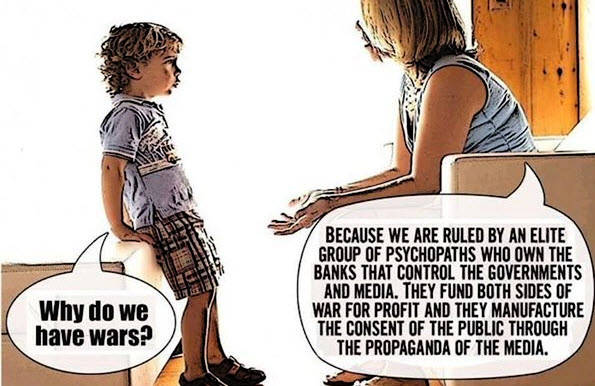
Creation & Deployment of NGOs Are Part of New Age of Hybrid Warfare
"It's The Outsourcing of Consensus Building Essentially Is What It Is"
-- Patrick Henningsen --
NGOs: Grassroots Empowerment or Tool of Information Warfare?
South Front
Published on Sep 30, 2016
If you’re able, and if you like our content and approach, please support the project. Our work wouldn’t be possible
without your help: PayPal: [email protected] or via: http://southfront.org/donate/ or via: www.patreon.com/southfront
|
NGOs, an extension of US foreign policy
|
NGOs, the Pentagon, and the Human Rights - Industrial Complex |
Chossudovsky: CIA's NGOs - the ABC of US foreign policy
|
|
The world is facing a decline in political rights and civil liberties, according to the organization Freedom House. Many US NGOs, like Freedom House, go into other countries to provide humanitarian aid but it seems their hidden agenda is to make these countries more like the US. Mark Weisbrot says many NGOs were set up to act as an extension of US foreign policy and set up in places like Venezuela and Haiti.
|
SHOW NOTES AND MP3: https://www.corbettreport.com/?p=18581 Patrick Henningsen of 21st Century Wire joins us today to discuss his recent article on "Smart Power & The Human Rights Industrial Complex." Topics discussed include the NGO/State Dept/Pentagon/NATO nexus, the use of human rights as a perception management tool to demonise NATO enemies, and the complicity of the media in reporting these stories uncritically. Behind The State Department's $40 Million Troll Farm RonPaulLibertyReport The Pentagon announced last week that it was sending $40 million to the State Department's "Global Engagement Center" to "counter foreign disinformation." Much of the money will go to creating US disinformation, to meddling in the internal affairs of other countries, and to more jobs at neocon NGOs pushing pro-war propaganda. It's a massive rip-off and worse -- we are the targets.
|
Russian opposition leaders and human rights activists pleaded with top US officials to support their plans for political and social change, but the request was apparently given short-shrift by Washington. Russia's Komsomolskaya Pravda newspaper, which obtained fresh files from WikiLeaks, reports that the group was consistently critical of the Kremlin and wanted American help for reform. Those demands were voiced on a visit to Moscow by Michael McFaul, Special Assistant to The President for National Security Affairs, who met with opposition leaders at the residence of the American envoy to Russia in Moscow. According to the reports, the opposition said: "Washington should pay more attention to significant incidents related to freedom of assembly in Russia. To solve problems in Russia's civic society, parties should sit down at the negotiation table -- both Russian and US governments, and representatives from NGOs." The US response was, "It is up to Russian activists to build up their relations with their administration, without relying on America." Michel Chossudovsky from the Center for Research on Globalization said it is no surprise that Russian opposition parties come knocking on the door of the US embassy. |
|
AL-Mayadeen: Patrick Henningsen on Smart Power and The New NGO Complex |
NGOs Behind the War on Libya - Julien Teil on GRTV
|
US NGO's not-so-charitable
|
|
The role which high-profile NGO and charities have played in the demonization and destablization of Syria is well documented by now. But does this mean that all the NGOs are doing the work of the Anglo-American deep state overseas? |
SUBSCRIBE IN ITUNES: http://ur1.ca/5gj2c RSS: http://ur1.ca/50ptm "The Humanitarian War" is a film about the demonization of Gaddafi in the run-up to the war in Libya. In this carefully researched documentary, Julien Teil examines the documents and interrogates the NGOs behind the campaign to oust Gaddafi, and shows the lack of evidence for the alleged war crimes that supposedly justified UN intervention. Join us for this week's GRTV Feature Interview with documentary filmmaker Julien Teil as we discuss the lead-up to the war on Libya, and whether it can happen again in Syria. |
Washington DC is home to the White House, Congress and more than 57,000 non-profit organizations. Call them think tanks, NGOs, policy forums or nonprofits, many provide vital services worldwide, while others are created for not-so-charitable purposes. |
NGOs Are The Deep State's Trojan Horses
corbettreport
Published on May 21, 2018
TRANSCRIPT AND SOURCES: https://www.corbettreport.com/ngo/
The Trojan horse was the earliest recorded military psyop. That psyop
continues to be deployed on unsuspecting populations and it is just as useful as ever, but today's tricksters
have donned the mantle of philanthropy, and their Trojan horses are not wooden statues but non-governmental
organizations offering "aid" to foreign nations. In today's edition of The Corbett Report, we'll learn about
how NGOs are the deep state's Trojan horses.
|
Bonnie Faulkner and F William Engdahl - April 2018 -
Jim Rogers 'Guns And Butter' Bonnie Faulkner talks to F William Engdahl about his new book 'Manifest Destiny: Democracy as Cognitive Dissonance'. Broadcast April 2018 |
Manifest Destiny: George Orwell’s famous novel, 1984, is a masterful fictional account of a state which imposes cognitive dissonance on its citizens to control their perception of reality. It is summed up in the statement, “War is Peace; Freedom is slavery; Ignorance is strength.” [Cont. Below] |
William Engdahl Manifest Destiny, Democracy as Cognitive Dissonance
William Engdahl says a blood thirsty NATO seeks endless wars and the overthrow of Russia and any other nation that gets in its way of total global domination. |
Manifest Destiny:
Democracy as Cognitive Dissonance
The story of this book, Manifest Destiny, is an account of how
agencies of US intelligence including the CIA and State Department, in collaboration with private “democracy”
NGOs, developed and refined techniques of Orwellian doublethink or cognitive dissonance to create a series of
regime changes around the world that sounded noble, democratic, but in reality were not. William Engdahl
describes the background beginning in the 1980’s with Reagan’s CIA Director leading to creation of a series
of private NGO’s to covertly manipulate aspirations for freedom and democracy from Poland and other communist
countries in the late 1980’s, to the Soviet Union to Yugoslavia and China. The book details the refinement of
what came to be called Color Revolutions by the early years of this century in Ukraine, Georgia and later
with the US-orchestrated Arab Spring. It’s an account of how elite circles in the USA and Europe along with
their think tanks refined methods to impose a new tyranny on countries from Ukraine to Egypt to Libya and
beyond. The aim was to use democratic aspirations of ordinary people, often youth, to topple regimes
resisting what David Rockefeller once called a One World Government, a global corporate tyranny. This is an
almost incredible chronicle of how select NGOS speak about freedom, human rights, democracy in order to bring
war, violence and terror. The book is a must read for anyone wanting to truly understand world events of the
past three decades or more.
https://www.amazon.co.uk/Manifest-Des...
Listen to this highly informative interview by SUNDAY WIRE host Patrick Henningsen who talks with best-selling author F. William Engdahl about his incredible new book, "Manifest Destiny: Democracy as Cognitive Dissonance", chronically the exploits of western clandestine agencies and their global 'NGO' revolution designed to destabilize societies and overthrow countless governments in the Eastern Europe, the Middle East, Asia and South America. See more details of this and other books by William here: www.williamengdahl.com/
"Consensus
Building"
Beware of both MSM & ALT-Media
WAR = Jobs, Jobs, Jobs?...NO, NO, NO!
An Important Rebuttal To What Was Proposed By Warmongering RAND Corp
"...Back in October 2008, we reported on how the RAND Corporation was lobbying for a war to be started with a major foreign power in order to stimulate the American economy and prevent a double dip recession." -- [Article Above]
No, World War II Did Not Help the Economy
-- Tom Woods --
|
No, World War II Did Not Help the Economy
TomWoodsTV Tom Woods replies to the common fallacy according to which World War II was a time
of great prosperity in the United States. www.LibertyClassroom.com/war |
The Myth of War Prosperity LibertyInOurTime Lecture presented by Robert Higgs at the Mises Circle in Houston: "Great Economic Myths," Saturday 29 January 2008; Sponsored by Jeremy S. Davis. http://mises.org Robert Higgs, Ph.D. is an American economist of the Austrian School and a libertarian anarchist. He currently serves as a Senior Fellow in Political Economy at the Independent Institute and is an adjunct faculty member of the Ludwig von Mises Institute and is an adjunct scholar at the Cato Institute. Dr. Higgs is also a regular contributor to LewRockwell.com. Click Youtube Button For Extensive Links |
War Causes Misery, Not Prosperity V for Voluntary Library
Recorded at the Mises Circle in Houston: "Great Economic Myths," Saturday 26 January 2008; Sponsored by Jeremy S. Davis. Source: mises.org/media/2351/The-Myth-... LUDWIG VON MISES INSTITUTE - CREATIVE COMMONS ATTRIBUTION 3.0 |


https://tomwoods.com/readings/
For more information on the economic effects of war, particularly World War II, see Robert Higgs,
Depression, War, and Cold War, as well as this longer, more in-depth video.
On the U.S. government’s Middle Eastern policy, see Donald Neff, Fallen Pillars: U.S. Policy Towards Palestine and Israel Since 1945. (Check Bookfinder.com for copies if Amazon doesn’t have many used copies.)
On war and government growth, see Robert Higgs, Crisis and Leviathan: Critical Episodes in the Growth of American Government.
On conservatism and war, see my resource page.
On the poor antiwar record of American liberals, contrary to popular belief, see chapter 7 of my book 33 Questions About American History You’re Not Supposed to Ask.
On how military spending deforms the economy, see chapter 5 of my book Rollback.
On the American antiwar tradition, see the book I co-edited with Murray Polner We Who Dared to Say No to War: American Antiwar Writing from 1812 to Now.
For the libertarian view of war, see Murray N. Rothbard’s “War, Peace, and the State” and Roderick T. Long’s “The Justice and Prudence of War: Toward a Libertarian Analysis.”
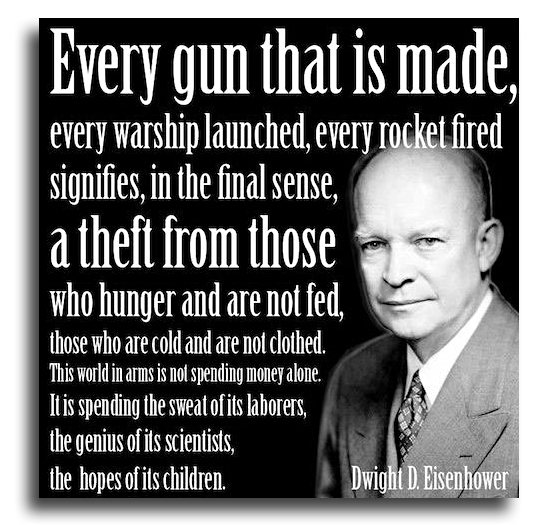
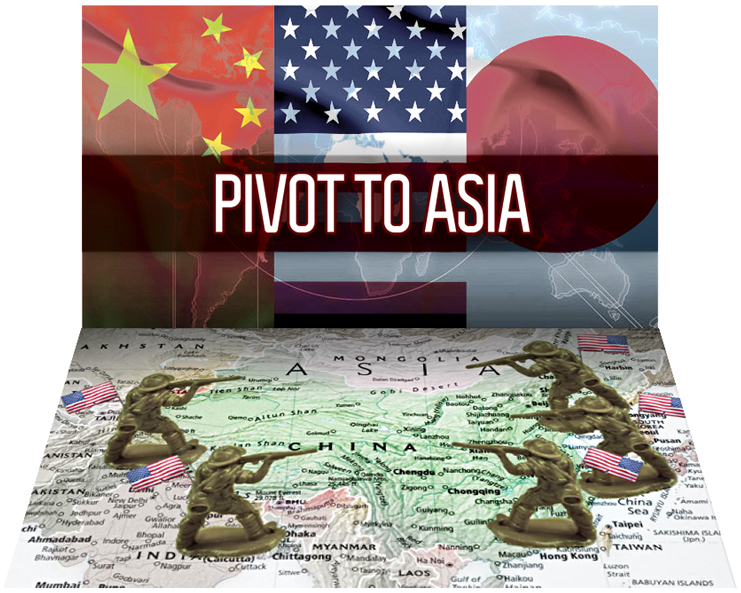
“…The United States in the region has a central
objective that does not concern Kim Jong-un or his nuclear weapons. Rather, it is driven by the perennial necessity
to increase forces in the region for the purposes of maintaining a balance of military force (Asian Pivot) and
ultimately trying to contain the rise of the People’s Republic of China (PRC).” --
Federico Pieraccini
|
Andrew Korybko - South Asia – new geopolitical battlefield
|
|
JaysAnalysis: Andrew Korybko on Hybrid Wars & Faux Revolutions (half) |

Andrew Korybko of Sputnik, Russia-Insider, Oriental Review, and Katehon joins me to discuss his
book Hybrid Wars: The Indirect Adaptive Approach to Regime Change. We cover the western geopolitical machinations
of regime change, color revolutions and manufactured coups in relation to recent events in Syria and the Ukraine.
Beyond that, we discuss the history of this same “technology” of manipulation in the older Balkan crises and
Putin’s role in bringing stability. Andrew’s book is a must-have for understanding the modern geopolitical
landscape. Andrew’s bio: “Andrew Korybko is a political analyst, journalist and a regular contributor to several
online journals, as well as a member of the expert council for the Institute of Strategic Studies and Predictions
at the People’s Friendship University of Russia. He specializes in Russian affairs and geopolitics, specifically
the US strategy in Eurasia. His other areas of focus include tactics of regime change, color revolutions and
unconventional warfare used across the world. His book, “Hybrid Wars: The Indirect Adaptive Approach To Regime
Change”, extensively analyzes the situations in Syria and Ukraine and claims to prove that they represent a new
model of strategic warfare being waged by the US.” www.jaysanalysis.com
Hybrid Wars: America’s Strategic Plan to Contain and Destabilize China
Part 6
(Please read Part I, Part II, Part III, Part IV, and Part V before this article)
The research has thus far extrapolated on Southeast
Asia’s global economic  importance and the most relevant points in its recent history,
which therefore set the appropriate situational backdrop for grasping ASEAN’s geostrategic significance. The
region plays a critical role in facilitating China’s international trade network, and it’s for this reason why
the US has sought to destabilize it and bring the waterways under its control. In response, China has
endeavored to break through the containment bloc being constructed against it and streamline two mainland
corridors as partial geopolitical compensation.
importance and the most relevant points in its recent history,
which therefore set the appropriate situational backdrop for grasping ASEAN’s geostrategic significance. The
region plays a critical role in facilitating China’s international trade network, and it’s for this reason why
the US has sought to destabilize it and bring the waterways under its control. In response, China has
endeavored to break through the containment bloc being constructed against it and streamline two mainland
corridors as partial geopolitical compensation.
Herein lies the New Cold War tension in ASEAN – the US is alternatively synchronizing both mainland and maritime portions of the Chinese Containment Coalition (CCC) in order to preempt Beijing’s ‘breakout’ from this region-wide geopolitical trap, while at the same time China continues to bravely push through its maritime and mainland agendas. On the waterborne front, the US can only resort to conventional power mechanisms to keep China in check and traditional alliance politicking, whereas the continental aspect of this containment campaign can incorporate more insidious tactics.
The major headway that’s been made so far with the China-Myanmar Pipeline Corridor and the ASEAN Silk Road has raised fears in Washington that Beijing has adeptly sidestepped the US’ South China Sea containment trap. In response, the US feels pressured to do whatever it can to seize control of the mainland ‘escape routes’ that China is charting in ASEAN, and if they can’t be geopolitically commandeered (like what appears to be happening in Myanmar at the moment), then the US won’t hesitate to unleash a Hybrid War to stop them.
China’s Geo-Economic Lifeline To Africa
ASEAN’s steady and consistent growth is attributable to a number of reasons, but first and foremost this has to do with its convenient geography that allows it to connect Eastern and Western Eurasian maritime trade. Ships passing back and forth from China, Japan, and South Korea on one hand, and the EU, Arica, the Mideast, and South Asia on the other absolutely must transit through Southeast Asia. A growing exception is emerging to this geo-economic rule, however, in that melting Arctic ice will soon make the Northern Sea Route a much more commercially viable option for EU-East Asian trade, but that won’t at all take away from Southeast Asia’s transit role for South-South economic interaction between China and Africa, the Mideast, and South Asia.
More specifically, though, the Indian Ocean and related Strait of Malacca and South China Sea access routes will progressively become more important for Chinese-African trade than any other as a result of the continental “Silk Roads” directly linking China with the Mideast (through the China-Iran railroad) and South Asia (through the China-Pakistan Economic Corridor and proposed BCIM corridor), provided of course that they’re successfully constructed. Whether they are or not, it won’t have an impact on China’s links with Africa because of the geographic incongruity of the continent to Eurasian connective infrastructure, ergo the motivation for the maritime portion of the One Belt One Road project.
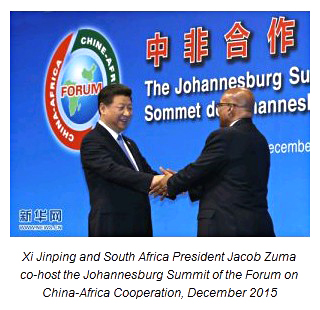 China’s second Africa policy paper that was revealed in December 2015 emphasizes the priority
that Beijing allots to strengthening full-spectrum relations with all of its African counterparts, specifically
in regards to the economic sphere. Likewise, a Silk Road conference in Lianyungang in September 2015 confirmed that China needs
African markets as destinations for its outbound investment, which in turn is predicted to sustain the country’s
growth rates well into the future and tangentially secure social stability. Understood in this manner, it’s of
paramount importance to China to guarantee itself free access to its African partners and prevent any
geopolitical impediments to bilateral trade.
China’s second Africa policy paper that was revealed in December 2015 emphasizes the priority
that Beijing allots to strengthening full-spectrum relations with all of its African counterparts, specifically
in regards to the economic sphere. Likewise, a Silk Road conference in Lianyungang in September 2015 confirmed that China needs
African markets as destinations for its outbound investment, which in turn is predicted to sustain the country’s
growth rates well into the future and tangentially secure social stability. Understood in this manner, it’s of
paramount importance to China to guarantee itself free access to its African partners and prevent any
geopolitical impediments to bilateral trade.
With the South China Sea gradually coming under heavy American influence and the Strait of Malacca already an American-controlled waterway, the impetus organically developed for China to spearhead a pair of overland ASEAN routes to the Indian Ocean that avoids both of them. The China-Myanmar Pipeline Corridor and ASEAN Silk Road are the geo-economic solutions to this dilemma, but they’re also the reason why the US has set its sights on swaying Myanmar, Laos, and Thailand away from China. If any of these governments steadfastly reject the respective outreaches presented to them, then the US will carry through on its tacit Hybrid War threats in order to destroy China’s containment-escaping infrastructure plans.
Stirring Up Trouble In The South China Sea
The Strategic Underpinning:
The whole reason that China has to resort to ‘escape routes’ in Myanmar, Laos, and Thailand is because of the trouble that the US has stirred up in the South China Sea. China’s merchant marine fleet can still navigate the waters as they see fit, but the growing strategic threat to their future freedom of movement is obvious. The Chinese have never been one to take unnecessary chances, especially when national security is at stake, so Beijing made the decision to lessen full dependency on the waterway and streamline two complementary mainland solutions in response.
Nevertheless, for the time being, the China-Myanmar Pipeline Corridor is still in its early stages, and the route itself is exceptionally vulnerable to rebel attacks, despite none having happened as of yet. Additionally, the non-resource economic aspect of this corridor has yet to be actualized, leaving a lot of valuable potential still waiting to be tapped. Concerning the other project, the ASEAN Silk Road hasn’t even been constructed yet and will still need a few years before it’s fully built and operational (if not over its entire route, than at least partially through Thailand and up to the Indian Ocean).
(Article Continues Below)
|
A Military 'Pivot to Asia'
|
Pivot to Asia |
US pivot seeks to contain China |
|
The US is up in arms over Chinese construction of islands in the South China Sea. US spy planes buzzing the islands are asked to keep away. Meanwhile, the US continues to construct more military bases in the region. |
CrossTalk: Chinese Wave 09Nov2015 RT News CrossTalk The most recent China wave on the remaking of the Pacific: over the last weeks Beijing and Washington have upped the ante in their game of chicken to determine who will have sway and influence. Do China and the U.S. face nearly endless trials between accommodation and confrontation?
CrossTalk on China:
In terms of foreign policy Donald Trump has already earned himself the title ‘the
low expectations president.’ This title is now being put to the test during his tour of Asia. Is
the US a status quo power in the Asia-Pacific region or merely a foil challenging China?
|
The United States is exploiting China’s territorial disputes with its neighbors as a pretext to justify its so-called pivot to the Asia-Pacific region and “contain” Beijing, a peace activist and analyst in Washington says. “This announced pivot to Asia was announced prior to the current controversies over disputed islands and disputed territories in the South China Sea and East China Sea,” said Brian Becker, national coordinator for the ANSWER Coalition, a US-based protest umbrella group consisting of many antiwar and civil rights organizations. “Those are in fact simply pretextual incidents and conflicts, allowing the United States to do what it really has sought to do from a strategic point of view, which is to move large numbers of military forces into the region, to contain China, to intimidate China, to disrupt China’s relations with other Asia-Pacific nations,” Becker told Press TV on Friday. Becker said recent comments by Admiral Scott Swift, the new commander of the US Pacific Fleet, constitute “an escalation of potential conflict between the United States and the People's Republic of China.” “Admiral Scott’s recent message is just one of many, a string of pronouncements by Pentagon officials seeking to camouflage the Pentagon’s aggressive intervention in the Pacific as somehow defensive in character and providing protection for smaller nations in the Pacific,” Becker observed. On Friday, Admiral Swift assured allies in the region that American forces are ready to respond to any unpredicted incident in the South China Sea, amid tensions over the disputed waters. The US Navy could increase deployment of combat ships, if necessary, and ramp up training exercises with its regional allies, Swift told journalists in the Philippines capital of Manila. He said his 200-vessel US Pacific Fleet, the world’s largest, “was ready and prepared to respond to any contingency that the president may suggest would be necessary.” Beijing claims sovereignty over nearly all of the South China Sea, which is also claimed in part by Taiwan, Brunei, Vietnam, Malaysia and the Philippines. Tensions have escalated between China and its neighbors over the South China Sea, where territorial |
(Article Continued)
This means that China’s dependency on its southern sea is still an important factor that could be exploited by the US until then, with the strategic window of opportunity narrowing by the year as the mainland ‘detour’ projects make progress and gradually come into use. In the event that either or both of the two projects is sabotaged or ‘indefinitely delayed’, then the US would predictably prolong and enhance the strategic vice grip that it’s gaining over one of China’s most vital trade conduits. Should Washington be successful in unleashing full-scale chaos in Central Asia and disrupting the Eurasian Land Bridge to Europe, then China would most certainly remain almost fully dependent on the South China Sea, and thus exceptionally vulnerable to US geopolitical blackmail there.
The Escalation Ladder:
The modern-day history of the South China Sea dispute is convoluted and controversial, but what’s less muddled is that China has had historical claims in the region for centuries that form the basis for its present position. Without getting into the nitty-gritty of the matter, it’s important to still document the general escalation progression that’s occurred since the US took the initiative to thaw out the long-frozen conflict. While there were clashes over some of the participants’ overlapping claims in the past, the issue had largely been put on the backburner of regional affairs, with all parties implicitly recognizing that it’s in everyone’s shared interest to maintain the peaceful and stable status quo. That dramatically changed after the US announced its Pivot to Asia at the end of 2011, and in the years since, Washington put tremendous pressure on Vietnam and the Philippines to aggravate the situation.
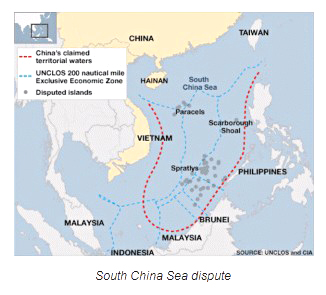 Hanoi and Manila’s revisionist actions (in the sense of modifying the
earlier established status quo) appeared to be a coordinated attempt at goading Beijing into an irrational and
emotional response. China’s leadership is well-versed in making calculated moves and it thus wasn’t tricked
into doing anything that could put its position in jeopardy. Actually, what it had decided to do was
surprisingly take the initiative in asserting its sovereign claims while cautiously avoiding any sort of
unnecessary military engagement (no matter how provocative) that could embroil it in a preplanned Pentagon
trap. China presciently saw the writing on the wall and realized that if it didn’t take the determined steps
that it had in reclaiming its island possessions, then Vietnam and the Philippines would have been in a
relatively stronger position to enforce their respective demands, and this could have easily allowed the US to
step in and take charge of the waterway.
Hanoi and Manila’s revisionist actions (in the sense of modifying the
earlier established status quo) appeared to be a coordinated attempt at goading Beijing into an irrational and
emotional response. China’s leadership is well-versed in making calculated moves and it thus wasn’t tricked
into doing anything that could put its position in jeopardy. Actually, what it had decided to do was
surprisingly take the initiative in asserting its sovereign claims while cautiously avoiding any sort of
unnecessary military engagement (no matter how provocative) that could embroil it in a preplanned Pentagon
trap. China presciently saw the writing on the wall and realized that if it didn’t take the determined steps
that it had in reclaiming its island possessions, then Vietnam and the Philippines would have been in a
relatively stronger position to enforce their respective demands, and this could have easily allowed the US to
step in and take charge of the waterway.
By standing up for itself in the face of American proxy aggression, China startled American decision makers that had been convinced that it would back down, and this in turn prompted them to harness all available information means at their disposal to discredit Beijing’s moves. Furthermore, while the US had earlier enjoyed ‘escalation domination’ in the South China Sea, it was now China that had seized the initiative and was fortifying its island locations, leading observers to wonder whether this ambiguously had defensive and/or offensive applications. Taken largely off guard, the US realized that the tables had turned and that China had regained its strategic position at Washington and its allies’ expense. In order to compensate for this, the US responded by pushing forward its preplanned strategy of multilateral escalation to evolve the dispute past its regional origins and into a larger Asian-wide one that draws in India and Japan.
The Excuse:
The US’ progressive heightening of the escalation ladder has the disturbing but very real potential to hit a ceiling of inevitable conflict sometime or another in the future, which might very well be what its ultimate plans are anyhow (albeit under conditions in which it has a monopoly of control). Washington’s first-tier Lead From Behind partners are entering the Southeast Asian theater through both maritime and mainland means, and India and Japan’s anti-Chinese involvement there (be it in economic, infrastructure, and/or military manifestations) are raising the barometer of proxy conflict to unparalleled levels. It should be remembered that India and Japan each of their own respective self-interests that they feel they are promoting through their provocative engagements there, and that to be fair, some of the governments (like in Myanmar, Vietnam, and the Philippines) are more than willing to enable them in order to reap the ensuing anti-Chinese advantages. These will be discussed more in the next section, but what’s important to realize is that the preplanned escalation that the US had initiated in the South China Sea has served as a very convenient excuse for all manner of tangential escalations since, every one of which is related to containing China in as multilateral of a fashion as possible.
The Chinese Containment Coalition
To accomplish the gargantuan task of containing China, a large-scale informal coalition of sorts is being assembled under American tutelage. The author comprehensively explored this massive undertaking in the article “Asian NATO-like Project To Be Stopped”, but it’s necessary to review some of its most important tenets in order to familiarize the reader with the neo-containment taking place. The Chinese Containment Coalition (CCC) is the neologism used to describe this de-facto alliance, and it has both maritime and mainland components to it. The most relevant utilization of the CCC of course relates to the South China Sea, and the US has a vested interest in maintaining the stability of each of its participating members in this geo-critical theater. It may, however, tinker with punitive Hybrid War threats to keep some of the members in check and/or create a plausible front for ‘justifying’ a deeper military commitment to each of them, although of course this could unintentionally spiral out of control and lead to unexpected consequences. The Hybrid War possibilities for each of the ASEAN states (both those that could ‘unintentionally’ erupt in the CCC and the ones purposefully planned against specific targets) will be extensively investigated later on in the work, but the focus right now is on the general shape and power relations within the CCC.
Membership Roster:
The CCC is a broadly inclusive strategic bloc whose members have their own motivations for containing China. The following is an enumeration of the states that are involved, as well as an explanation of what they believe to be their self-interested reasons for participating:
US
Washington is most of all motivated by concrete geostrategic considerations, believing that the containment of China is a necessary action in order to indefinitely prolong American hegemony over Eurasia. China is one of the three Great Power multipolar centers pushing back against the US’ dominance over the supercontinent (with the other two being Russia and Iran), and the US wants to acquire geopolitical leverage over it by controlling its vial mainland and maritime economic conduits in Southeast Asia. The US is fearful that a rising China could spearhead a revolutionary system of post-modern international relations based on win-win benefits and genuine partner equality (the very concept behind the One Belt One Road endeavor), and coupled with Beijing’s rising naval capabilities, it believes that China might become powerful enough to weaken Washington’s unipolar stranglehold over the region. If the US’ control over Southeast Asia begins to deteriorate, perhaps concurrent with a parallel process underway in the Mideast, then the US would suffer a major geopolitical blow from which its hegemonic control might never be able to fully recover.
Japan
The island state has always been China’s chief geopolitical and civilizational rival, and the present tensions between the two amount to nothing more than an American-manufactured return to history. Japan aspires for leadership of the entire East and Southeast Asian space, believing that its historical naval superiority and maritime identity entitles it to play a premier role in guiding regional events. To add some substance to its grand ambitions, it’s also the only country aside from the US that has the excess capital and management experience necessary to compete with China in developing this rapidly growing bloc. Furthermore, while Japan’s World War II history of conquest in Southeast Asia was objectively a very dark and brutal time for the region, much of the public and their corresponding leadership have been whipped up into such an anti-Chinese nationalist frenzy as of late that they seem willing to overlook the negative facts during this time period and dwell only on its positive anti-colonialism connotations.
The relevance of this to the present day is that the US has been largely successful in convincing people in Vietnam and the Philippines that China is the latest colonizer to creep into the region, with the subtle intimation being that a ‘reformed, non-imperialist’ Japan can preemptively liberate them from their coming servitude. Tokyo already wants to deepen its hold over the ASEAN’s markets (both commercial and military) as it is, and being literally called in by some of the region’s members to do so and with the full backing of the US is just about the greatest soft power boost that it could have ever hoped for. The constructed narrative at play here is that the Chinese ‘bad guy’ is trying to control the region and its maritime resources, while the ‘anti-Chinese good guy’, Japan, is willing do whatever it takes to counter it, with the ‘trusted’ US keeping an eye on it to make sure it doesn’t relapse into any of its colonialist habits. The irony is that it’s Japan and the US, not China, which are bent on a neo-colonialist power grab in Southeast Asia, but the unipolar-influenced information services in the region have largely mirrored their European counterparts in parroting their patron’s talking points and disseminating a false reality.
India
New Delhi’s strategy in all of this is to constrain the rise of its natural geopolitical rival, and this has seen it take a gradually more vocal stance in addressing the South China Sea crisis. For the most part, India’s leadership has played coy with China in pragmatically interacting with it in large-scale multilateral frameworks such as the AIIB, BRICS, and the SCO, but in being noticeably less constructive when it comes to indirect bilateral relations. To explain, India’s dealings with states and regions of mutual interest to it and China tend to be much more competitive and reek of zero-sum proxy intentions on New Delhi’s part, for example, when addressing ‘freedom of navigation’ in the South China Sea together with Japan or in unilaterally blockading Nepal. There’s an undeclared butclearly observable Cold War going on between both Asian great powers, despite neither of them willing to publicly admit it, and it’s in this context that India has a desire to provoke China in Southeast Asia. Although it has yet to send any naval vessels to the region, the possibility hasn’t been explicitly discounted by New Delhi, and it’s quite probable that it could find some pretext to do so in the future (be it under ‘freedom of navigation’ auspices or to participate in a multilateral CCC drill there).
(Article Continues Below)
|
US pivot to Asia threatens China, region
|
The Asian Pivot
|
One Belt One Road and Two Wars? China Spars with North Korea and India |
|
The Obama administration’s so-called pivot strategy in the Asia-Pacific is a provocative move that poses a threat to China and other countries in the region, an anti-war activist and journalist in Maine says. US President Barack Obama’s pivot policy is being implemented to “surround and control China” and restore Washington’s “global dominance as China rises,” said Bruce Gagnon, the coordinator of the Global Network Against Weapons & Nuclear Power in Space. “China is really not a threat, it's Obama’s pivot of military forces into the Asia-Pacific which is the real threat,” Gagnon told Press TV on Tuesday. “It’s totally crazy, it’s provocative, it’s highly expensive and it has serious environmental implications,” he added. The Obama administration is trying to keep its focus on a widely advertised shift to Asia, which it has pursued since 2011. The White House argues that no region is more important to the United States’ long-term interests than Asia. The peace activist said the US military budget last year was equal to 34 percent of global military spending, while China was at 12 percent and Russia at 4.8 percent. “So it’s clear that neither China nor Russia are a military threat to the US; that in fact the United States is the one causing the instability in this case and really can’t afford to keep doing it anymore.” Gagnon said the Pentagon’s emphasis on large aircraft carriers in the Pacific is financially unsustainable and outdated and is bankrupting the country. According to a report released earlier this month by the Rand Corporation, a global policy think tank, the US should decrease its emphasis on expensive aircraft carriers in the Asia-Pacific and spend more on submarines, space capabilities and ways to make air bases and aircraft less vulnerable to a Chinese attack.Since 1996, China’s ability to threaten the US Navy surface fleet “at significant ranges from the mainland” has multiplied, the report said. “Over the next five to 15 years, if US and (People’s Liberation Army) forces remain on roughly current trajectories, Asia will witness a progressively receding frontier of U.S. dominance,” the report noted. A recent assessment released in April by the Carnegie Endowment for International Peace, argues that the Obama administration’s Asia pivot has not been successful and American power and influence in the region has been declining. Observers believe America’s efforts to increase its presence in the Asia-Pacific region is aimed at containing China. China accuses Washington of meddling in the regional issues and deliberately stirring up tensions in the South China Sea. |
Dan Collins speaks with Max Keiser on the Asian Pivot.
|
This week on Newsbud’s China Watch with Peter Lee: One Belt One Road and Two Wars?
China Spars with North Korea and India. Also, Miles Kwok goes large. Day of reckoning for Erdogan’s
Uyghur adventure. And anti-Chinese agitation shadows Indonesia. Show Notes http://bit.ly/2pUHye9 Support Newsbud on Kickstarter http://kck.st/2pKsbbC Newsbud Academy Registration & Course
Description http://bit.ly/2pftsXC Join the Newsbud
Community http://bit.ly/2gbO5ii Visit our website http://bit.ly/2gl9jbd Follow Newsbud on Twitter http://bit.ly/29d5XFD Follow Newsbud on Facebook
bit.ly/2kEdiRY |
(Article Continued)
Adding to that, India is clearly a rising power in its own right, and the self-confidence that this comes with has encouraged its elite to spread their country’s influence to surrounding regions. The so-called “Cotton Route” that was suggested as an institutional counter-weight to the New Silk Road will likely stretch into Southeast Asia, considering the historical bond between India and the region that was described in the second chapter. India’s political basis for doing so is termed “Act East”, and it’s Modi’s evolved version of his predecessor’s much more passive “Look East” policy. It includes not only ASEAN, but also Japan as well, and the interplay between both of the US’ Lead From Behind proxies in the geographic middle ground of Southeast Asia will be described soon enough. Physical proximity is an obvious enabler in accelerating India’s bilateral relations with ASEAN, and theTrilateral Highway between it, Myanmar, and Thailand (the ‘ASEAN Highway’) is designed to physically integrate the subcontinent’s SAARC with the neighboring ASEAN bloc. Suffice to say, this project’s successful completion would directly infuse Southeast Asia with a steady stream of Indian economic and institutional influence that could pose a sizeable challenge to China, and its particular effect on Myanmar’s anti-Chinese pivot will certainly be elaborated on later in the research.
Vietnam
The mainland ASEAN leader of the CCC has a vehement dislike for China, despite its larger neighbor ironically being its biggest trade partner. In some ways, this actually plays into the anti-Chinese rhetoric and political ambitions of some of Hanoi’s elite, since they were able to spin this successfully enough as a form of ‘Chinese hegemony’ that the rest of the government fell for the nationalistic knee-jerk reaction of agreeing to get on board with the US-led TPP. Anti-Chinese nationalism is at such a high level among the most influential elements of Vietnam’s leadership that the once-proud country has even backtracked on its historical principles by closely allying with its former US tormentor in ‘countering’ its northern neighbor. As was earlier discussed when describing the long history of Chinese-Vietnamese relations, there’s definitely an ingrained distrust of China interwoven into Vietnamese identity due to the country’s millennium-long incorporation into the Empire, but the US plainly exploited this psychological trait by initiating the timed thawing of the South China Sea dispute.
Information warfare specialists were likely consulted well in advance in order to craft the most effective ways in which the Vietnamese audience could be misguided into interpreting unrequested American diplomatic interventionism as ‘Chinese aggression’. The sum effect of this nationalist-appealing information manipulation has been that the anti-Chinese forces in the country decisively won out over the pragmatic ones and that Vietnam ultimately made its choice in aligning with the unipolar-oriented forces that are militarily and economically circling China. By becoming the US’ mainland beachhead in the CCC, Vietnam likely hopes for American acceptance of what will probably soon be a renewed attempt at resurrecting its leading role in the former French lands of Indochina. Hanoi still has sizeable institutional influence over Vientiane (particularly military and economic), although it’s of course been relatively dwindling since the end of the Cold War, while Vietnam has urgently been trying to play catch-up with China in Cambodia ever since its military withdraw in 1989 re-opened the door to Beijing’s influence. Vietnam’s counter-proposal to both of its neighbors’ chummy ties with China is a so-called “development triangle” between them, which will in reality serve as a vehicle for the return of Vietnamese influence to these countries.
The Philippines
The former American colony is much weaker than China by all metrics, and its population is easily riled up by simple fear mongering techniques. In turn, it presents itself as a tantalizing target for the US’ anti-Chinese information operations there, which are ultimately predicated on returning the Pentagon’s presence to the island chain. The American footprint is all over the Philippines owing to the colonial and post-World War II past (essentially a continuation of the former arrangement albeit under the more acceptable-sounding label of ‘independence’), but Washington’s overbearing presence had the predictable aftereffect of engendering strong anti-American emotions that eventually manifested themselves in the 1986 overthrow of proxy leader Ferdinand Marcos and the 1991 order for the US’ full military withdrawal. The military campaign against southern separatists and Muslim terrorists (which have regretfully merged into a semi-unified movement that mostly discredits the former at this point) resulted in the return of US special forces to the country in 2002 on the basis of anti-terrorist cooperation.
The one-and-off insurgency that has been fought since then provided the necessary pretext for embedding the US’ military personnel deeper into the country and making them an integral part of the Philippines’ anti-terrorist ‘tool set’, but it wasn’t sufficient for the full return of forces that the Pentagon initially had in mind. The 2011 Pivot to Asia and subsequent American agitation of the South China Sea dispute served the purpose of stoking nationalist sentiment in the country that was professionally channeled by the US and its affiliated information actors (both formal TV and web ones and informal ones such as NGOs) into a self-serving anti-Chinese direction. The US’ plan was to have the Philippines, once formerly colonized by it, go as far as formally inviting the US military presence back into the country on the grounds of defending its South China Sea claims from an ‘aggressive China’. Even still, domestic political sensitivities to such a move evoke heightened emotion even to this day, ergo why the US had to euphemistically ‘settle’ for an Enhanced Defense Cooperation Agreement in April 2015 that gave it the right to periodically “rotate” its forces out of 8 or more Filipino bases but stopped short of outright giving it formal control of the facilities there. For all intents and purposes, this amounts to the exact same thing, but it’s described differentially via the ‘rotating’ loophole so as to assuage patriotic Filipinos that are dead-set against a US military return to their formerly dominated nation.
The present situation in the Philippines is actually somewhat of a paradox – for as nationalistic and proud as most of the population is, many people are apathetic (or even welcoming) to the return of American forces to their country, having been misled to the point of believing that a re-occupation by their former occupier whom they previously ousted is somehow more preferable than a full-spectrum and pragmatic partnership with China. This confounding contradiction only serves to demonstrate the effectiveness of the US’ information warfare operations, and it also speaks volumes about the subservience and outright collaboration of various elements of the Filipino elite. The political individuals that publicly support the US’ military return to the Philippines either naively don’t realize that this is a reiteration of the same imperialist blueprint, or more realistically are well aware of this but have positioned themselves so as to profit quite handsomely from this arrangement. It cannot be underscored enough just how much of a contravention of the Philippines’ national interest it is for the country to ‘re-invite’ the US military back onto its territory, and while private individuals could be somewhat forgiven for having fallen victim to the US’ rabid anti-Chinese nationalist information warfare, their governing elites have no such excuses and are fully complicit in their country’s reoccupation.
Australia
Canberra’s involvement in the CCC is minimal but symbolic, and it proves the extent that Australia is willing to go to behave as the ‘junior America’ in its corner of Southeast Asia. The Australian elite generally harbor political ambitions that don’t correlate to their country-continent’s actual potential, and militarily ruffling China’s feathers in a high-stakes game of chicken is certainly one of them. It’s been revealed that Australia has been carrying out provocative ‘freedom of navigation’ flights over the South China Sea, despite formally having positive relations with China through a recently signed Free Trade Agreement. It’s necessary at this point to draw a distinction between Australia’s economic and military loyalties, as these don’t correspond to one another. The FTA with China hints at a pretense of pragmatism, yet Australia’s military-strategic loyalty to the US is completely counter-productive to any of the broader positive inroads that the economic pact could yield in the future. The clear abrogation of national interest that this entails is symptomatic of the Australia political elites’ prevailing inferiority complex vis-à-vis the US and other Western countries, as Canberra seems intent to score points with its Anglo-Saxon peers and gain their ‘acceptance’ at the tangible expense of endangering ties with itsnumber one economic partner.
This shortsighted policy is inherently untenable and cannot continue to exist indefinitely, however, it’s not likely that China would respond with any punitive economic measures so soon after signing the FTA. Additionally, Australia is betting that China needs its iron resources more than it needs China’s economic patronage for them (although this is a dubious gamble), but given that the arrangement is mutually beneficial for the time being, Beijing isn’t prone to cut it loose anytime soon. Provided that Australia keeps its provocations to a bare minimum and at as low of a scale and intensity as possible, China will probably ignore it aside from possibly issuing a strongly worded statement against it, but it’s extraordinarily difficult to maintain such an unnatural balance when the US will inevitably encourage it to do more in the future. Australia also believes that it present actions of anti-Chinese provocation are endearing it closer to some of its new ASEAN free trade partners, but they too (especially Vietnam and the Philippines) will likely join forces with the US in calling for a more active Australian presence in the South China Sea.
(Article Continues Below)
|
China’s Maritime Strategic Realignment |
US 'Asia pivot' plan in shambles, ties with key partners sour |
China's New World Order: Gold-backed oil benchmark on the way |
|
If you’re able, and if you like our content and approach, please support the project. Our work wouldn’t be possible without your help: PayPal: [email protected], http://southfront.org/donate/ or via: www.patreon.com/southfront Subscribe our channel!: www.youtube.com/channel/UCaV1... |
Mass anti-government protests in South Korea, along with a change of rhetoric by some other US allies in the region, including the Philippines, have upset the apple cart for the US and its Asia pivot, says Brian Backer of the Answer Coalition.
|
SHOW NOTES: www.corbettreport.com/?p=23932 China has announced a "new world order" for world oil markets that could have profound effects on the global economy and the monetary order itself. But as The Shanghai International Energy Exchange gears up for operation, it's important to note yet again that this is another engineered conflict with the pre-determined death of the dollar system being used to bring in the new multipolar world order that the NWO has been openly working toward for decades. |
(Article Continued)
Canberra probably didn’t anticipate this when it initially signed on to the CCC (however low-commitment it may thought it would be), so eventually it’s going to be pressed into making a difficult decision in choosing between its main economic and strategic partners (China and the US, respectively). The caveat, however, is that China’s iron ore-purchasing dependency on Australia will make it reluctant to take any concrete measures against its ‘partner’ even if it ramps up its anti-Chinese activity, and until it finds a third major partner to diversify its imports from besides Brazil, it’s probably going to be inclined to preserve the status quo of economic relations. On the other hand, as the FTA enters into full swing and begins more actively involving sectors outside the mining one, it’s possible that China could establish a few unforeseen strategic footholds in the Australian economy that might come in handy for ‘leveling the playing field’ and deterring any further unnecessary Australian aggression in the South China Sea.
Power Hierarchy:
The CCC operates under a simple power hierarchy that is expressly dominated by the US. It can be conceptualized via the basic model below:
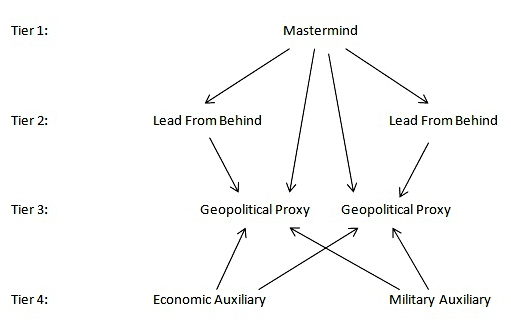
The following model adds detail to the framework and accommodates it for the specificities of the CCC's South China Sea mission:
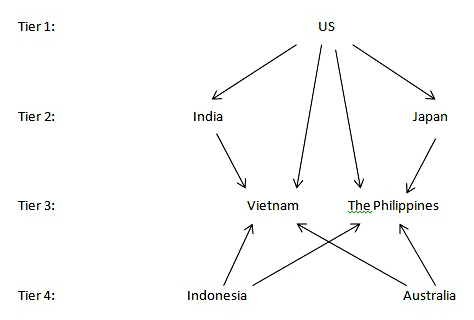
It’s pretty easy to understand the power flow in the abovementioned hierarchies. The US, as the militant enforcer of unipolarity, has partially contracted its regional responsibilities to its two trusted Lead From Behind partners, India and Japan. In turn, the three of them (albeit on different levels and to varying degrees) cooperate with Vietnam and the Philippines, the CCC’s most geopolitically relevant proxies in the South China Sea. Bringing up the rear, Indonesia’s potential inclusion in the TPP would provide a serious boost to the CCC’s economic efforts, while Australia’s military presence, although extraordinarily minimal at the moment, could be beefed up to a bit more of an impactful contribution in the future.
The concept is also relevant for explaining the CCC’s activities in mainland ASEAN, with scarcely any membership modifications needed:
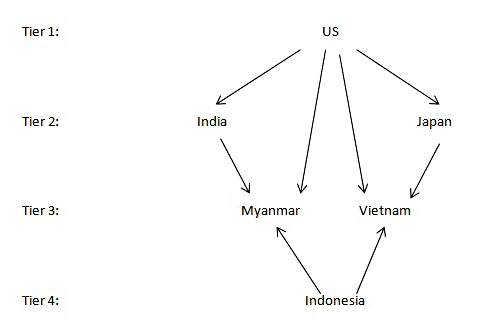
The first two tiers and power motivations remain the same in this adaptation, with the only differences being that Myanmar substitutes for the Philippines and Australia is removed from the equation. The reasoning for this is obvious, since the Philippines aren’t a part of mainland Southeast Asia and Australia has no realistic possibility for militarily assisting in any CCC operation in this region. If anything, the UK’s base in Brunei gives it the faint possibility of replacing Australia as the auxiliary military actor in this framework, but even that appears to be unlikely owing mostly to the fact that the mainland portion of any forthcoming containment campaign will result in a lot less of a direct military presence for all actors. As will be argued later on in the research, it’s much more foreseeable that Hybrid Wars will be utilized in place of the type of conventional military containment witnessed in the South China Sea.
Geopolitical Convergences:
The two above-cited conceptual models aptly illustrate the geopolitical convergences between the CCC’s maritime and mainland missions, with Vietnam functioning as the consistent proxy element between them because of its dual identity. Partially speaking, Vietnam is a maritime nation because of its extensive coastline and claims over part of the South China Sea, while it’s also equally a mainland country as well and has the potential to reestablish its sphere of influence over Laos and Cambodia, two of China’s most important ASEAN partners. This makes it doubly important for the US and its Lead From Behind partners to enter into its good graces so as to fully exploit the geopolitical advantage this would provide for them in their shared CCC goal.
There are a few particulars that deserve to be expanded upon in order to understand nuances of the CCC’s overall mission in each of these two sub-theaters:
Maritime
To approach the maritime region first, the common space between Vietnam and the Philippines is the South China Sea and the myriad islands between them, ergo the present focus on provocative ‘freedom of navigation’ bomber flyovers and warship transit. There’s little in terms of strategic asymmetry that the US and its allies can do in ‘countering China’, so for the most part (save for creative military-technical innovations), conventional alliance dynamics predominate this vector of geopolitical competition. Therefore, events here are a lot more predictable because they simply boil down to whether or not there will be a direct military clash between China and the CCC, although the situation does get increasingly tense and dramatic the more that the US provokes China into acting.
Eventually, it seems almost inevitable that one side or the other will lose their cool and make a regretful decision, but even in the event that this happens, it’s very likely to be contained. The exception would occur under the circumstances that the US chooses to escalate an engagement between China and either of the two geopolitical proxies (Vietnam, or more likely, the Philippines) to the point of bringing in the Lead From Behind partners (India, but more foreseeably, Japan) to provide indirect back-up support and institutionalize the CCC. This scenario is easier to conceptually understand if the reader replaces the Philippines with Ukraine and China with Russia, thus allowing one to perceive of the strategic structural continuities between both Eurasian containment operations. Just as Ukraine’s US-provoked aggression against Donbass created the pretext for NATO to deepen its involvement in the former’s affairs, so too would the Philippine’s possible US-provoked aggression against China in the South China Sea function as a pretext for the CCC (especially its US and Japanese elements) to further embed themselves into the island nation.
Even so, the China vs. CCC dynamic still remains largely linear and conventional, thus making it predictable to a large extent. The same, however, certainly can’t be said for the mainland portion of this rivalry.
Mainland
Matters are infinitely more complicated, and therefore dangerous, in the CCC’s strategy for mainland ASEAN. As seen from the previously mentioned model, Myanmar and Vietnam are the ‘geopolitical bookends’ in this sub-theater, with each respectively falling deeper under their nearby Lead From Behind overseer’s influence. For example, India’s ASEAN Highway stands to position New Delhi as one of Myanmar’s most vital economic partners, while Japan is heavily investing in all sectors of Vietnam’s economy and is one of its most important full-spectrum strategic partners. Thailand, Laos, and Cambodia are critically positioned in between the CCC’s mainland proxies, with Japanese-led investment projects strategically bridging the physical gap between them.
For example, the Asian Development Bank (ADB, commonly understood as an institutional tool of US-Japanese policy) and direct Japanese investment are being used to help fund a bunch of multisided physical integrational projects in the Greater Mekong Subregion (the ADB’s official jargon for mainland Southeast Asia plus southern China). One should keep in mind that the CCC’s funding extends mostly (but not exclusively) to the East-West and Southern Corridors that link both coasts of mainland ASEAN, and that Japan is building the Thai sections of both high-speed rail projects. Tokyo is also a major investor in Myanmar’s Dawei SEZ, so taken together with its railroad ambitions, it’s plain to see that Japan has staked its Greater Mekong Subregion interests in facilitating connective infrastructure projects between both of the region’s coasts.
The picture below demonstrates these and the other associated projects:
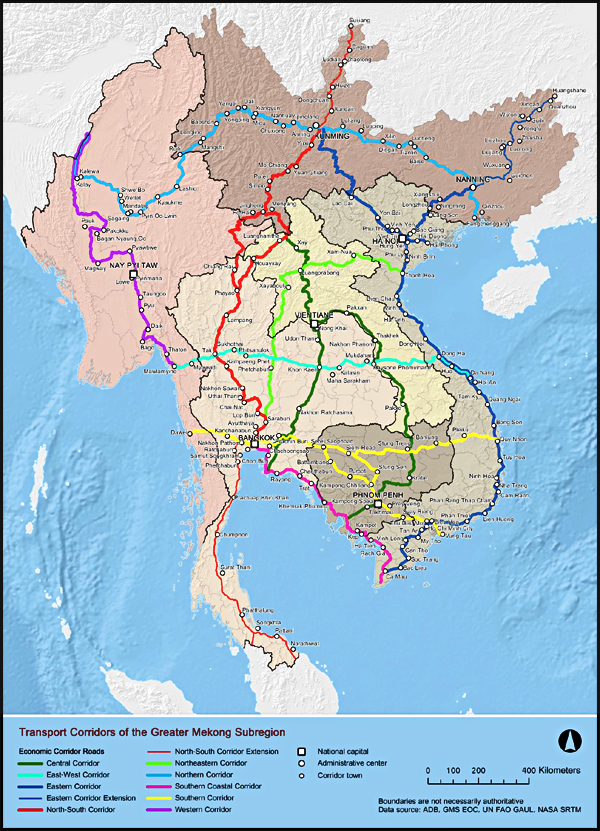
The red line running from China to Thailand is the ASEAN Silk Road that was mentioned earlier in the work, which is China’s ‘escape route’ for evading the South China Sea trap that the CCC is setting for it. While the map suggests that this could dually run through Myanmar and Laos, it’s highly unlikely that it will ever be constructed (let alone remain secure) in the largely rebel-held portions of the former. The changing nature of domestic politics in Myanmar, which is rapidly moving along a pro-Western trajectory, also bodes quite negatively for that prospective route’s political feasibility. It’s much more likely then that China’s ASEAN Silk Road (formally described by the ADB as the “North-South Corridor”) will remain completely dependent on Laos for its transit access to Thailand, the infrastructural hub of the Greater Mekong Subregion. In fact, China is actually moving forward with two Thai-destined railroad projects simultaneously, with the relevant “Central Corridor” spoke forming an integral part of Beijing’s present railroad construction plans, and it’s this additional ‘artery’ that’s expected to form the actual basis of the ASEAN Silk Road.
Remembering that it was earlier written that Cambodia is a structurally unreliable ally of China owing to the lack of direct connective infrastructure to its partner, the reader returns to the conclusion that Laos and Thailand are China’s only true geopolitical partners in mainland ASEAN. The situation with Cambodia could theoretically be remedied and the bilateral partnership considerably strengthened well past its already positive and pragmatic nature via the completion of the Cambodian portion of the Central Corridor route through Laos, but that project is far from a priority in the face of the much more strategically urgent North-South Corridor and “Central-North-South Corridor” linking China with Thailand. These projects acquire such strategic importance precisely because Myanmar’s westward pivot is rapidly diminishing the prospects that the China-Myanmar Pipeline Corridor will ever expand into an all-out economic one as was originally envisioned, and also because the ASEAN Silk Road could be modified near its tail end to reach a to-be-constructed terminal along Thailand’s Indian Ocean (technically Andaman Sea) coast. Thailand might not even have the proper harbor or port conditions for what China could be planning as its ultimate contingency plan, but that’s not to say that China simply couldn’t build whatever it needs in its desired geographic location, considering the engineering ‘miracles’ it’s pulled off in the South China Sea.
The Indian-Japanese Double Flank
It’s relevant at this juncture to highlight the CCC’s guiding geopolitical concept for ‘countering China’ in the Greater Mekong Subregion (mainland ASEAN), and that’s the ‘Indian-Japanese Double Flank. It’s been thus far described that India’s primary avenue of approach into the region is via the ASEAN Highway through Myanmar (the “Western Corridor” as described by the ADB in the above-cited map), while Japan’s strategy has been to link the region’s two coasts through the East-West and Southern Corridors. What’s pretty much happening here is that India is moving eastward into the region while Japan is moving westward, and their point of ultimate convergence is Thailand, which also just so happens to be China’s primary focus as well.
Just like any traditional flanking strategy, the target is moving in a linear direction while the opponents are striving to simultaneously flank it from both angles. In this actual situation, China is streaming southward while India and Japan are rushing to block it via their respective advances from the west and the east. Geostrategically speaking, the greatest point of friction for all parties lay at or near the planned perpendicular intersections of the unipolar and multipolar projects in Northern and Central Thailand, and in a theoretical sense, that’s where one would be inclined to believe that a clash of interests could occur. The reality is a bit different, though, since it’s technically possible for Thailand to accommodate both geopolitically divergent projects and create an ultimate win-win situation for everyone.
As beneficial as this may be for all of the directly involved parties, US strategists would beg to differ, since it’s their ultimate aim to keep the CCC firmly on its anti-Chinese course and not to have its main supportive members (India and Japan) partially deterred out of a shared strategic interest with Beijing, which in this case is the stability of Thailand.
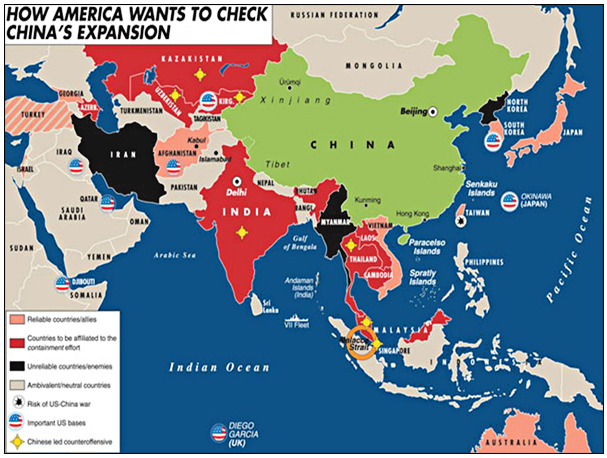
To be continued…
Andrew Korybko is the American political commentator currently working for the Sputnik agency. He is the post-graduate of the MGIMO University and author of the monograph “Hybrid Wars: The Indirect Adaptive Approach To Regime Change” (2015). This text will be included into his forthcoming book on the theory of Hybrid Warfare.
PREVIOUS CHAPTERS:
Hybrid Wars 1. The Law Of Hybrid Warfare
Hybrid Wars 2. Testing the Theory – Syria & Ukraine
Hybrid Wars 3. Predicting Next Hybrid Wars
Hybrid Wars 4. In the Greater Heartland
Hybrid Wars 5. Breaking the Balkans
Top New World Order Quotes
"We are grateful to The Washington Post, The New York Times, Time Magazine and other great publications whose directors have attended our meetings and respected their promises of discretion for almost forty years. It would have been impossible for us to develop our plan for the world if we had been subject to the bright lights of publicity during those years. But, the work is now much more sophisticated and prepared to march towards a world government. The supranational sovereignty of an intellectual elite and world bankers is surely preferable to the national autodetermination practiced in past centuries." David Rockefeller [June, 1991]
LINKS: N.W.O. | The United Nations | Road to World Government
Skull & Bones Society Built Atomic Bomb
- Manhattan Project Secrets Revealed -
LINK:
Skull and Bones, The Order at Yale Revealed
"The fact that governments lie is generally
accepted today, but World War I was the first global conflict in which millions of young men were sacrificed for
hidden causes. They did not die to save civilization; they were killed for profit and in the hopes of establishing
a one-world government."
- Jim Macgregor, Gerry Docherty -
Prolonging the Agony:
How The Anglo-American Establishment
Deliberately Extended WWI by Three-and-a-Half Year
Watch All Three Videos & More Here: General Summary/Crash Course
|
|
|
THE CIA An independent agency of the United States government responsible for collecting and coordinating intelligence and counterintelligence activities abroad in the national interest; headed by the Director of Central Intelligence under the supervision of the President and National Security Council...There has been considerable criticism of the CIA relating to security and counterintelligence failures, failures in intelligence analysis, human rights concerns, external investigations and document releases, influencing public opinion and law enforcement, drug trafficking, and lying to Congress. In 1987, the former CIA Station Chief in Angola in 1976, John Stockwell, said the CIA is responsible for tens of thousands of covert actions and destablization programs since it was created by Congress with the passage of the National Security Act of 1947. At the time, Stockwell estimated that over 6 million people had died in CIA covert actions.
LINK: C.I.A.
|
|
THE FBI The Federal Bureau of Investigation (FBI) is a governmental agency belonging to the United StatesDepartment of Justice that serves as both a federal criminal investigative body and an internal intelligence agency (counterintelligence). Also, it is the government agency responsible for investigating crimes on Indian reservations in the United States under the Major Crimes Act. The branch has investigative jurisdiction over violations of more than 200 categories of federal crime. The agency was established in 1908 as the Bureau of Investigation (BOI). Its name was changed to the Federal Bureau of Investigation (FBI) in 1935. The agency headquarters is the J. Edgar Hoover Building, located in Washington, D.C. The agency has fifty-six field offices located in major cities throughout the United States, and more than 400 resident agencies in lesser cities and areas across the nation. More than 50 international offices called "legal attachés" exist in U.S. embassies and consulates general worldwide. 'Federal Bureau of Investigation organizes almost all terror plots in the US' ...The report reveals that the FBI regularly infiltrates communities where they suspect terrorist-minded individuals to be engaging with others. Regardless of their intentions, agents are sent in to converse within the community, find suspects that could potentially carry out “lone wolf” attacks and then, more or less, encourage them to do so. By providing weaponry, funds and a plan, FBI-directed agents will encourage otherwise-unwilling participants to plot out terrorist attacks, only to bust them before any events fully materialize.
LINK: F.B.I.
|


NATO
North Atlantic Treaty Organization
Ever since its inception there have been those who have
warned that the North Atlantic Treaty Organization, far from offering a simple "collective security" pact to ensure
the integrity of its member nations' borders, would in fact be used as an offensive tool of imperial adventurism
and conquest. Since the NATO-led Kosovo bombing campaign of 1999 at the very least, those fears have appeared more
and more justified.
Since that time, NATO has continued to take a lead role in more and more overtly
offensive campaigns of aggression in theatre after theatre. By now it is commonly understood to be an extension of
the Pentagon itself, a convenient international military instrument for Washington to wield whenever the pretense
of an international consensus cannot be achieved at the UN Security Council.
-- James Corbett
NATO is the first attempt in history to establish an aggressive global military formation, one which currently includes a third of the nations of the world either as members or partners, has members and partners on five continents and has conducted active operations on four, with the potential to expand its reach into the remaining two where it has not yet officially intruded itself...As NATO continues to expand across the globe through a series of partnerships, initiatives and dialogues, what was once a collective security agreement is increasingly becoming a global military strike force capable of bombarding, invading and occupying countries anywhere in the world.
http://rickrozoff.wordpress.com/about/
LINK: NATO
|
A General Summary/Crash Course of "The
System" |
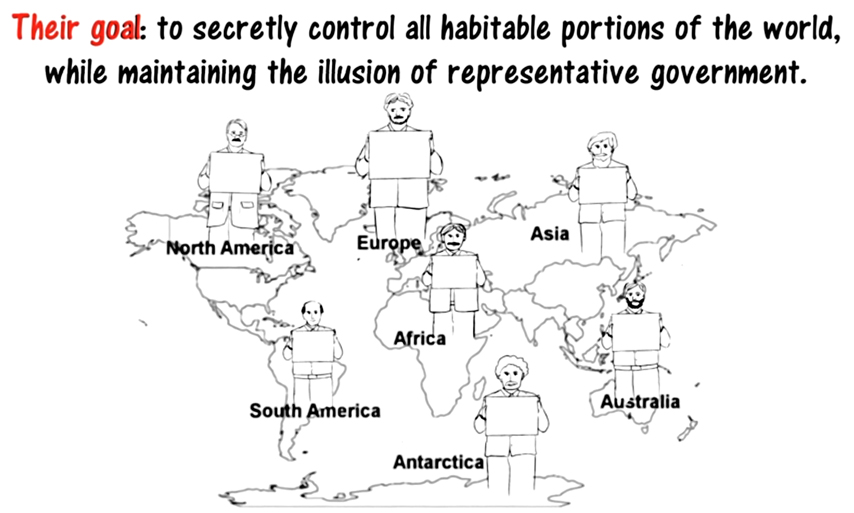
LEARN HOW THE REAL POLITICAL SYSTEM WORKS HERE: TRAGEDY & HOPE 101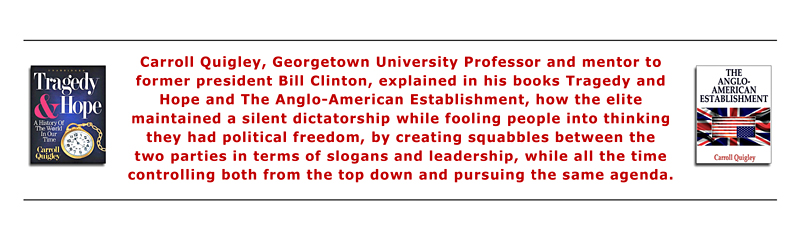
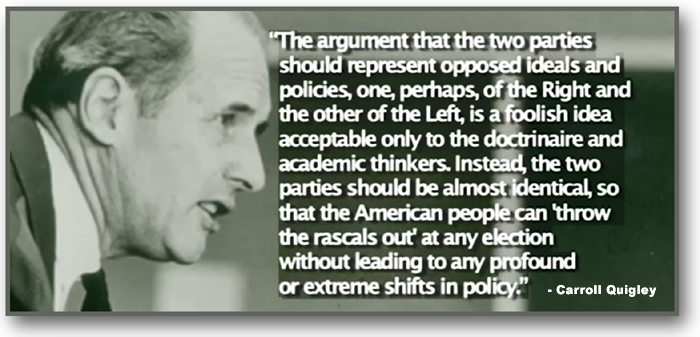
Is "democracy" just a carefully managed con game? Professor Quigley not only spent decades researching and writing about those who secretly control the machinery of our “representative governments,” he was permitted to examine their secret papers. He was invited in, but he ultimately betrayed their trust when he exposed their plans and their methods.
- Joe Plummer -
G. Edward Griffin The Quigley Formula
Bill Clinton And More From The Archives!
Jason Bermas
Premiered Aug 20, 2019
G. Edward Griffin The Quigley Formula Bill Clinton And More From The Archives!
Another great speaker who lays out a compelling narrative of history in the archived series!
https://www.gofundme.com/f/bermasbrig...
Bitcoin - 1HHdgXD5e1DJrDqbEGWbnvzj2eb739eVVo | #BermasBrigade #BritishRoyalty
#ThePredatorClass

LINK: General Summary/Crash
Course
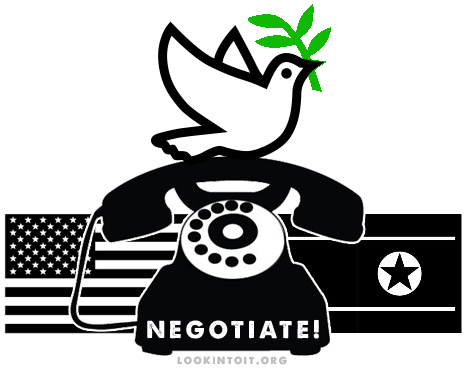
North Korea and
the Dangers of Nuclear War:
Towards the Implementation of a Peace Project
https://www.globalresearch.ca/what-you-need-to-know-about-north-korea-and-the-dangers-of-nuclear-war/5615328
|
America's War on the People of Korea: Michel Chossudovsky GlobalResearchTV
|
The Prospect of a Korean Peace Treaty - Gregory Elich in Seoul GlobalResearchTV
|
The Report of Peace Committee of KAUMC at 2016 GC
Korean Association of United Methodist On May 19, 2016 General Conference turned to a presentation of the Committee on Peace of Korean Association of UMC. They reported their efforts to bring about peace and reconciliation on the Korean peninsula. Bishop Carcaño, presiding the afternoon session, highlighted the small wooden Korean “peace Crosses” that have been part of this General Conference. She noted that they were made in the part of Korea where Wisconsin Area Bishop Hee-Soo Jung is from. |
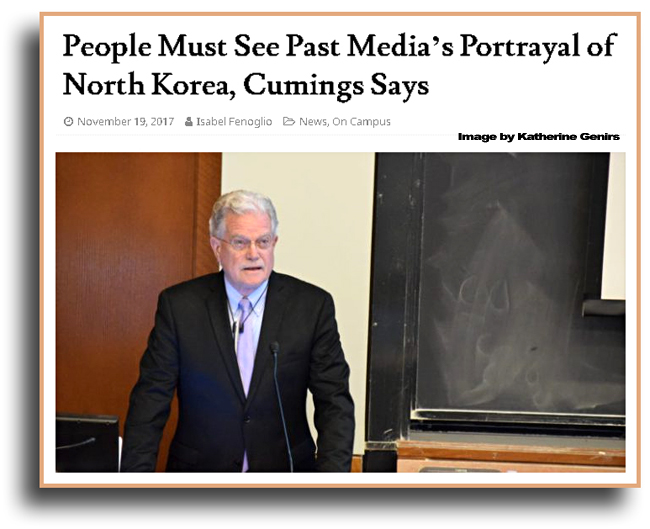
People Must See Past Media's Portrayal of North Korea, Cumings
Says
Isabel Fenoglio News, On Campus
November 19, 2017
Bruce Cumings, a history professor at the University of
Chicago, addressed a tightly packed audience in Devlin 008 on Wednesday about what he considers to be the most
serious crisis the world faces today: North Korea.
In a lecture titled, “The Sources of North Korean Conflict,” Cumings outlined the complex history of United States and North Korean relations. Cumings told students that in order to resolve relations, people need to figure out what makes North Korea “tick,” to discover why they do what they do.
Cumings argued that in many ways, North Korea shares characteristics with the late USSR, and cited the famous article “The Sources of Soviet Conduct” by George Kennan as evidence.
“Understanding the rise and subsequent collapse of the USSR is essential to understanding North Korea,” Cumings said.
However, a notable difference between North Korea and the USSR is expansion. With the exception of Japan, North Korea does not seek to expand beyond the Korean peninsula, Cumings said, but instead pursues policies of isolationism and exclusionism.
Cumings identified North Korea as the most amazing garrison state in the world. North Korea has the fourth largest army in the world. The U.S. has the third largest. The North Korean army serves as the underlying source of power in North Korea.
“Anyone who talks about conquering North Korea, waiting for it to collapse, or decapitating its leadership will have to reckon with its army,” Cumings said. “To defeat North Korea would be an endeavor that the U.S. has not amounted to since WWII.”
While there has been no major conflict between the U.S. and North Korea since the Korean War ended in 1953, there is currently an armada of power up against North Korea waiting to strike, he said.
Cumings characterized the border between North and South Korea as “the most tense border on the planet today,” adding that the common maxim among troops is “ready to fight tonight.”
This tension directly contributes to public unease in regards to U.S. and North Korean relations, and Cumings said that the media does not help in easing the public’s fear.
[Bold Added] “Do not believe most of what you hear, they are mostly just scare stories” he said.
Cumings criticized the media for its “caricature-esque” portrayal of North Korea and encourage the public to pursue alternative sources for information on the conflict. This is because, in moments of crises, the media will take any bad story about North Korea and run with it, regardless of veracity, he said.
In order to reach a complex understanding of relations between the U.S. and North Korea, Cumings said that the U.S. needs to see through the media’s portrayal of the country.
When asked how to go about restoring U.S. relations with North Korea, Cumings said that diplomacy must change. He criticized the current militant and antagonistic strategies of the Trump administration, calling them acts of absurdity.
“We need to start giving out carrots as well as sticks,” Cumings said.
http://bcheights.com/2017/11/19/people-must-see-past-medias-portrayal-north-korea-cumings-says/

|
Criminalize War Clubs
corbettreport TRANSCRIPT AND SOURCES: www.corbettreport.com/?p=6984 As the anti-War movement continues to lose ground in the West due to widespread public support for the illegal wars of the Obama administration, an innovative new approach emerges from SouthEast Asia: the creation of student-run organizations designed to energize youth around the concept of criminalizing war. Find out more about this idea in this week's GRTV Backgrounder. LINK: What Can We Do? |
World War III Is Over Corbett Report Extras FULL LECTURE: www.corbettreport.com/?p=24001 We may be looking at the echoes of WWI, but we are no mere shadows consigned to
observe the events taking place around us. We are conscious actors with the ability to give our
identities over to the next "great" war cause, or to retain our humanity and refuse to give in. And
make no mistake: your choice does make a difference. |
The Weaponization of Information in the War of Terror corbettreport TRANSCRIPT AND SOURCES: www.corbettreport.com/?p=22963 If terrorist incidents are always tied back to shadowy groups linked to Al Qaeda or ISIS, an online, independent media might connect those dots to show how Al Qaeda and ISIS were literally created, fostered, funded, trained and equipped by the UK government, the US government and their allies across the world as a tool in their quest of dominance of the Middle East and control of their domestic population. But such a story can only be told on a free and open internet, where independent voices continue to reach the masses and inform them of the truth about these terror groups. |
South Korea’s Sunshine
Policy:
80 Percent of South Koreans Support Peace and North-South
Engagement For South Koreans, the biggest threat to peace isn't North
Korea but the United States.
William Blum on the Korean War
Killing Hope: US Military and CIA Interventions Since World War II
| “...T | hroughout the war, a continuous barrage of accusations was leveled by each side at the other, charging the enemy with engaging in all manner of barbarity and atrocity, against troops, prisoners of war, and civilians alike, in every part of the country (each side occupied the other's territory at times), trying to outdo each other in a verbal war of superlatives almost as heated as the combat. In the United States this produced a body of popular myths, not unlike those emerging from other wars which are widely supported at home.(By contrast, during the Vietnam War the inclination of myths to flourish was regularly countered by numerous educated protestors who carefully researched the origins of the war, monitored its conduct, and publicized studies sharply at variance with the official version(s), eventually influencing the mass media to do the same.)" |
Link : Answering The Problems of Evil and Suffering
| “I | don't know what types of alliances are possible. All we can do is to hold aloft the banner of justice and humanity and see who rallies to it. And no matter who joins us, fight we must. For as Ludwig von Mises said, ‘Everyone carries a part of society on his shoulders; no one is relieved of his share of responsibility by others. And no one can find a safe way out for himself if society is sweeping toward destruction. Therefore, everyone, in his own interests, must thrust himself vigorously into the intellectual battle. None can stand aside with unconcern; the interest of everyone hangs on the result…' Let’s all stand together.” |
-- Tom Woods, Ludwig von Mises --

https://mises.org/store/We-Who-Dared-to-Say-No-to-War-P539.aspx
http://www.lewrockwell.com/2008/09/thomas-woods/we-who-dared-to-say-no-to-war/
We Who Dared to Say No to War uncovers some of the forgotten but compelling body of work from the American antiwar tradition—speeches, articles, poetry, book excerpts, political cartoons, and more—from people throughout our history who have opposed war. Beginning with the War of 1812, these selections cover every major American war up to the present and come from both the left and the right, from religious and secular viewpoints. There are many surprises, including a forgotten letter from a Christian theologian urging Confederate President Jefferson Davis to exempt Christians from the draft and a speech by Abraham Lincoln opposing the 1848 Mexican War. Among others, Daniel Webster, Mark Twain, Andrew Carnegie, Grover Cleveland, Eugene Debs, Robert Taft, Paul Craig Roberts, Patrick Buchanan, and Country Joe and the Fish make an appearance. This first-ever anthology of American antiwar writing offers the full range of the subject’s richness and variety.
LINK: WE WHO DARE SAY NO TO WAR!
It's no telling what these maniacs might do to get a war started...Stay Super Vigilant
|
All America's Wars Begin with False Flags (and WWIII Will Too) This D.C. think tank jerk off blatantly admitted all of America's wars have traditionally begun with false flag events, and they know they will need another one to get the war with Iran started that they've been working on for so long. This video is a few years old now, but it's more relevant today with what's going on in the Middle East than ever. They don't teach you this in school, kids, but whatever happens over there, just realize how absolutely manufactured all of it is. |
|
Ron Paul Fears False Flag To Start New Korean War The Alex Jones Channel
|
Missing Nuke Investigation: Special Report
Top nuke commanders Navy Vice Adm. Tim Giardina and Maj. Gen. Michael Carey terminated
following exclusive high level military intelligence over secret nuclear warheads transfer.
http://www.infowars.com/top-nuke-comm...
http://www.storyleak.com/
http://www.infowars.com/video-radio-host-michael-savage-calls-for-answers-over-missing-nuke-report/
Senator
Warns of
S. Carolina Nuke Strike
http://www.infowars.com/sen-graham-warns-of-nuke-strike-after-missing-nuke-report/
Sen Lindsey Graham has warned of a nuclear strike in S Carolina following the report by Alex
Jones and Anthony Gucciardi about low key nuke transfer from Texas to South Carolina.
http://www.infowars.com/exclusive-hig...
Exclusive: High Level Source Confirms Secret US Nuclear Warhead Transfer
Radio Host Michael Savage Calls For
Answers Over
Missing Nuke Report
Radio host Michael Savage joins in calling for answers
over secret nuke transfer
Anthony Gucciardi
Infowars.com
October 13, 2013
Top radio host Michael Savage has joined in calling for answers regarding the leaked secret transfer of nuclear weapons to South Carolina that was followed by both warnings of a nuclear strike by South Carolina Senator Lindsey Graham and the termination of the top two US nuke commanders.
Originally reported by myself and Alex Jones back on September 3rd, a number of disturbing red flags have continued to give further evidence to the high level military intelligence source that initially exposed the transfer of the off-the-record nuclear warheads from Dyess Air Force base to South Carolina — and still, the irrelevant mega media has ultimately failed to even investigate. Once again, the real media continues to dominate along with investigative radio personalities in reporting on the news that matters.
As Savage points out, specifically speaking on my report last Friday concerning how the termination of a high level nuke commander coincided with the exact September 3rd date of the secret transfer, what we truly need is answers. And while we are already talking about an issue that is deeply concerning at a base level, what really give the secret transfer a disturbing amount of depth are the events that followed the leaked intel.
It was Senator Lindsey Graham who came out later on the same day in warning against a ‘nuclear attack’ in South Carolina if we did not take military action in Syria. Then we also consider the fact that two of the top nuke commanders in the United States were terminated for laughable reasons, and it becomes an even larger red flag scenario. What is most amazing to me, however, is the fact that the termination of the commanders was actually leaked to the Associated Press and others.
What this means is that United States government did not want us to know that the commanders were terminated — specifically that the second top commander was fired on the same day as the secret nuke transfer report.
When we look back at the ’2007 United States Air Force nuclear weapons incident’, where nukes were reported missing from the Minot Air Force Base with no official suspect, the media went into turmoil and investigations were launched immediately. Even CNN covered the event in depth and continued to investigate what was going on. The CNN reporter even stated that “this kind of thing is not supposed to happen” in response to the event:
But where is the mainstream media now? Once again, it is up to us to get the word out and demand answers. My respect goes out to Michael Savage for demanding answers on such a pertinent and real issue.
This article originally appeared on Anthony Gucciardi’s Storyleak
This article was posted: Monday, October 14, 2013 at 5:42 am
Tags: dyess air force, michael savage, missing nuke, nuclear warheads, nuke transfer
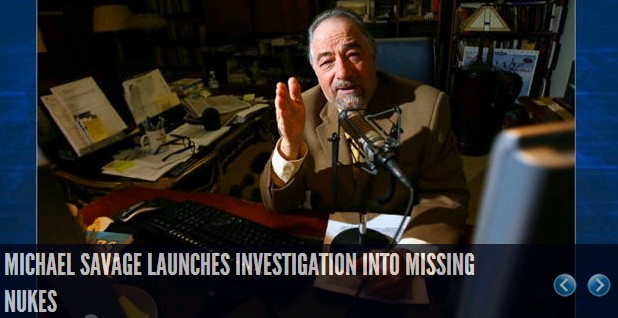
Michael Savage Launches Investigation
Into
Missing Nukes
Anthony Gucciardi
Infowars.com
October 28, 2013
Radio host calls for media attention over missing nuke report and termination of top nuke commanders
Since Alex Jones and I originally reported on the high level military intelligence revealing that an unsigned nuclear weapons transfer had taken place back on September 3rd, an absurdly high number of red flag events lending credibility to the intel have followed. From the termination of the second highest nuke commander in the country on the exact same day as the leak, to Senator Lindsey Graham warning of a nuclear strike on the exact destination of the missile transfer — the red alert scenarios continue to pile up.
And now, Michael Savage of Savage Nation is launching an investigation into the issue and calling upon the media to properly address the situation.
I joined the Savage Nation to discuss the intel timeline of the nuke transfer, specifically highlighting the fact that the transfer was unsigned for and completely off the books. Originally covered by Savage earlier this month following the suspension and termination of the two top nuke commanders in the nation, the missing nuke intel has since spread internationally — and still, the United States media has failed to even mention it despite the vital events that continue to point towards its accuracy.
But that fact is nothing new, considering the reality that even the local media was quick to ignore sources revealing the unsigned transfer to them. As usual, the mainstream media is deathly afraid of crossing the establishment. After all, it’s who grants them their reach (and oftentimes funding).
The brief report from the top level military source, which was written in a rush to get the information out, reads:
“Dyess is beginning to move out nuclear war heads today. I got a tap from DERMO earlier. He said it was the first time they have been even acknowledged since being put there in the 80′s. No signature was required for transfer… There was no directive. He said that Dyess Commander was on site to give authority to release. No one knew where they were going really, but the truck driver said to take them to South Carolina and another pick up will take them from there.”
———-
Anthony Gucciardi is a writer, analyst, and Founder of Storyleak.com whose articles are routinely featured on top sites like Drudge Report and regularly appears on national and international television media.
This article was posted: Monday, October 28, 2013 at 11:57 am
Tags: dyess air force base, michael savage, missing nukes, savage nation
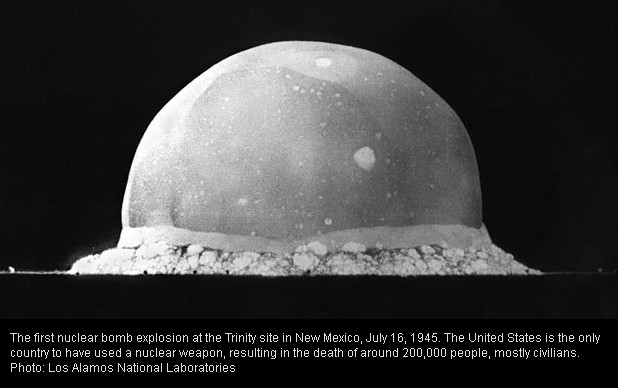
Obama’s Worried Manhattan Will Get Nuked
Kurt Nimmo
Infowars.com
March 25, 2014
The first nuclear bomb explosion at the Trinity site in New Mexico, July 16, 1945. The United States is the only country to have used a nuclear weapon, resulting in the death of around 200,000 people, mostly civilians. Photo: Los Alamos National Laboratories
During a press conference in the Netherlands today, Obama said he is more worried about Manhattan getting nuked than any supposed threat posed by Russia.
The president made the remark after a reporter asked him if former challenger Mitt Romney was correct in his assertion that Russia is once again the primary foe of the United States following Crimeans voting to rejoin Russia.
“Russia’s actions are a problem. They don’t pose the No. 1 national security threat to the United States. I continue to be much more concerned when it comes to our security with the prospect of a nuclear weapon going off in Manhattan,” Obama said.
Obama did not elaborate on the threat.
North Korea has threatened to nuke the United States on several occasions. Last April, the Defense Intelligence Agency concluded with “moderate confidence” North Korea has a nuclear weapon small enough to be loaded on a ballistic missile. However, according to the DIA, the reliability of the missile would be low.
The previous December South Korea, for obvious reasons, said North Korea had developed the technology capable of delivering a nuclear weapon to the West Coast of the United States. Experts, however, said at the time the hereditary communist state is years away from miniaturizing a nuclear weapon and mounting it on a ballistic missile.
California is approximately 3,000 miles from Manhattan. In order to nuke New York, the North Koreans would require a missile capable of traveling around 9,000 miles.
[vid]
The next suspect on the Axis of Evil list the government has claimed for over a decade wants to do us harm is Iran. It currently does not have a nuclear bomb and, in fact, has not enriched uranium to the level required for a bomb, and also does not possess a missile capable of striking the United States. In January, Secretary of State John Kerry insisted Iran has pledged to stop stockpiling uranium.
After the September 11, 2001 attacks, the government and various commentators told us on numerous occasions al-Qaeda has planted nukes around the United States and will “kill millions, destroy the economy and fundamentally alter the course of history.”
In 2010, Obama said al-Qaeda is trying to get nukes and would have “no compunction in using them.” He added if “there was ever a detonation in New York City, or London, or Johannesburg, the ramifications economically, politically and from a security perspective would be devastating.”
U.S. intelligence officials, however, say the al-Qaeda nuclear threat is, at best, a remote possibility.
“At this point, they don’t appear to have made much progress, but we continue to review every bit of information that comes in to determine whether they’ve advanced their efforts in any way whatsoever,” an anonymous intelligence official told CNN in 2010. “Developing a nuclear device involves a highly sophisticated technical process, and al-Qaeda doesn’t seem to have mastered it based on what we know now.”
Obama apparently does not consider Russia a threat, although it currently has around 45,000 nuclear weapons and a sophisticated ballistic missile system.
Russia, according to Obama, is a “regional power that is threatening some of its immediate neighbors, not out of strength, but out of weakness.”
Obama made the remark while speaking with Dutch Prime Minister Mark Rutte after a nuclear security summit in The Hague. Russia attended the summit and endorsed the meeting’s final statement on enhancing nuclear security.
Russian Deputy Foreign Minister Dmitry Rogozin threatened to use nuclear weapons if Moscow was attacked. He made the remark following discussions about missile defense systems installed in Eastern Europe by the United States.
“One can experiment as long as one wishes by deploying non-nuclear warheads on strategic missile carriers,” Rogozin said. “But one should keep in mind that if there is an attack against us, we will certainly resort to using nuclear weapons in certain situations to defend our territory and state interests.”
This article was posted: Tuesday, March 25, 2014 at 1:25 pm
The Secret Behind Obama's Nuke False Flag
Alex Jones breaks down why Obama is bringing up a nuclear attack in New York City.
During a press conference in the Netherlands today, Obama said he is more worried about Manhattan getting nuked
than any supposed threat posed by Russia.
The president made the remark after a reporter asked him if former challenger Mitt Romney was correct in his
assertion that Russia is once again the primary foe of the United States following Crimeans voting to rejoin
Russia.
http://www.infowars.com/obamas-worrie...
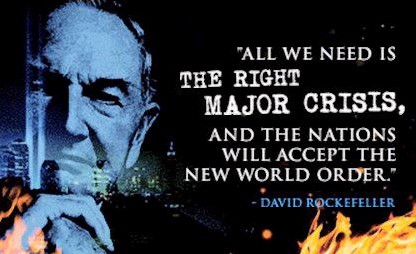
LINKS: False Flag Event | N.W.O.

REACH OUT TO OTHERS
[Help Educate Family And Friends With This Page And The Links Below]
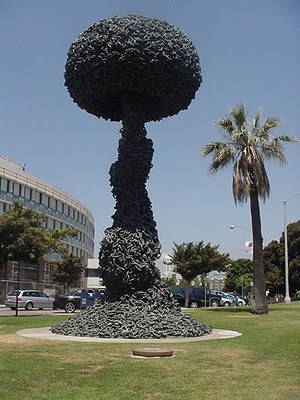
MORE:
Psywars - The Selling Out of Alex Jones/Infowars
Foreign Troops Training To Confiscate Guns of Americans
UN Arms Transfer Treaty (ATT) on Small Arms: Gun Grab Gradualism

| << Previous [1] 2 Next >> |